As the world’s most valuable company by stock valuation, Apple has been under the gun when it comes to the working conditions of workers within its supply chain. Recently Apple released its 2012 Supplier Responsibility Report that disclosed what the company was doing to address work environment violations by its suppliers. The company has also been the first tech company to join the Fair Labor Association, which is currently auditing Foxconn factories in Shenzhen, China, as seen on ABC’s special ‘iFactory: Inside Apple’.
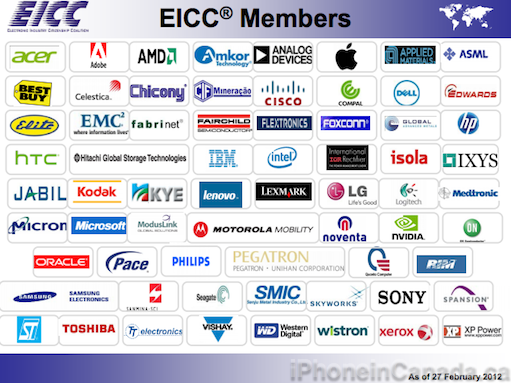
Now, a Bloomberg report notes other technology companies such as Microsoft, Dell, HP, and Samsung don’t necessarily do the same as part of the Electronic Industry Citizenship Coalition (EICC), which Apple is also a part of. The argument is the EICC can’t force its members to disclose findings of worker abuse and does not hold members accountable:
Hewlett-Packard Co. and Samsung Electronics Co. rely on their own evaluations, based in part on guidelines from the Electronic Industry Citizenship Coalition, which they say are sufficient to prevent abuses.
Though Apple’s decision to join FLA may not root out all instances of labor abuse, the EICC’s member companies may open themselves to even harsher criticism. While the EICC sets standards for ethics, worker safety and labor practices, it doesn’t require members to disclose findings and it lacks enforcement powers. The result is a disjointed system of self- imposed regulations that fail to hold companies accountable when abuses arise, according to labor advocates and technology executives.
“They are absolutely toothless,” said Tom Fallon, chief executive officer of Infinera Corp. (INFN), a Sunnyvale, California- based maker of telecommunications equipment that hasn’t joined the EICC because Fallon says the group isn’t effective. “I don’t think they do meaningful work.”
Given the pressure on Apple to be transparent when it comes to its supply chain working conditions, I’m surprised it has taken this long to bring up other companies into the mix. We have had a look inside Apple’s assembly lines at Foxconn–but how do they stack up against similar product assembly lines from companies like Dell, Amazon, Nintendo, HP, and Microsoft? The EICC currently has 67 members that includes some of the largest companies in the world. It appears pressure is mounting to have other companies reveal their own audit findings, like Apple.
What do you think? Should all companies disclose the working conditions of their supply chain, or only when they run into their ‘Nike’ moment?



I was wondering about this when the media started grilling Apple about their suppliers responsibility report. I completely agree all direct and indirect competitors to Apple should also disclose their activities to mitigate workers abuse, especially in Asian countries.
But here’s the main difference: Apple has US$98 Billion cash reserve and a gross profit margin of over 44%; while all its competitors are much lower. Samsung’s gross margin is around 16%, Dell & HP around 20%.
So because of the size of Apple, they can squeeze its suppliers to achieve this stunning cash reserve and gross margin level. Its competitors do not have similar clout, and they don’t have much “room” to raise their suppliers’ profit to improve working condition.
OTOH, Apple can well afford to “relax” their squeeze on its suppliers a bit to improve working condition. Just a 1% lower gross profit margin would mean millions for the workers. Of course, in this corporate world, this would never happen. They would defend and vie for increasing profit margin at all cost, in the name of increasing shareholders’ value, even at the expense of workers in foreign country.
So what you’re saying is that lower profit margins justifies squeezing more out of your suppliers? Based on your information, it’s more important than ever for the rest of the companies to disclose their supply chain working conditions to prevent struggling companies from finding their profit through leveraging their power/position over the less fortunate.
Ensuring basic human rights when possible has little to do with whether a company thinks it can afford it or not IMO.