Chris Stavropoulos from Xcrew.net has analyzed the cost of bandwidth comparing Canada versus the rest of the world:
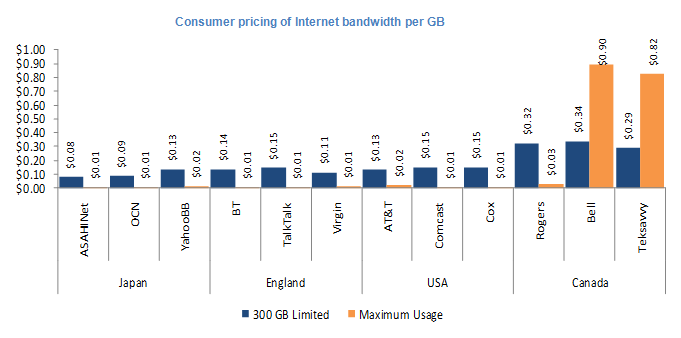
There are several key points of interest in this data.
1. The only country where unlimited bandwidth is actually more expensive than the 300 GB limit is Canada. This can be attributed to the fact that Canadian providers include a per-GB overage charge above 300 GB.
2. Unlimited bandwidth in Canada is up to 90 times more expensive than other countries.
3. By limiting the bandwidth to the Canadian provider maximum of 300 GB, Canadian customers are still paying more than twice that of any other country.
4. The pricing for Rogers in the 300 GB limited dataset is comparable to other Canadian Internet providers while their unlimited pricing is much closer to the rest of the world. This is due to the fact that Rogers currently has a $50 maximum charge for overage fees. Usage based billing (UBB) pricing is expected to come into effect for cable internet providers later this year which is likely to bring their pricing more in line with DSL providers such as Bell.
This data shows that of the countries examined Canada is by far the most expensive country to surf the web. This is due in no small part to monopolistic practices such as UBB brought about by the incumbent telecommunications providers. The inability of Canadian carriers to provide competitive levels of service and pricing compared to other countries is a sad testament to the lack of diversity and competition in the Canadian marketplace.
There’s not much to say, as the numbers speak for themselves. Canadians are kind people, yet we only complain, but don’t break out the torches and pitchforks. We also have relatively short term memories (straight out of movie Memento). Big Canadian telcos are smart enough to recognize this, and prey upon us at their will.
Times are changing though, as the StoptheMeter.ca campaign has reached over 334,000 signatures. This ‘noise’ caused by you and I has resulted in the CRTC head being called in front of a MP committee to explain his actions.
Let’s continue to make our voices heard! Visit StoptheMeter.ca and tell your friends!




Two thumbs up!!
I find it sort of unfair to have TekSavvy on there. They are forced to use Bell’s rates, having them on here makes it seem like it’s their fault.
There are some key players missing here, making the study useless.
Should of compared TekSavvy before the UBB change.
As a side note on this whole UBB thing… I don’t want a faster speed to get a higher cap (Big telcos!). I would prefer to keep my same speed but just raise the cap like the small guys offer.
You cannot simply compare the US, Japan and England to Canada. The population density is on an entirely different level. When you have a low population density it is going to cost more to provide coverage to everyone, these costs get passed on. At the same time a lower population forces companies to have higher profit margins per customer to cover costs such as infrastructure.
The country that Canada should be compared to is my country, Australia. Canada is much closer to Australia in terms of population and infrastructure needs.
Agreed, Telus should have been used instead.
Hmm… Let’s say the Pop. of Canada is 30m, the UK at 50m, USA at 300m, Japan at 150m, and Australia is 20m. Now… let’s look at isolation… the UK is pretty close to Europe, and Canada is butt up against the USA, and… Australia is next to… New Zealand… No, I’d say Canada, USA, England, and Japan was a fair comparison; would have liked to have seen data for S. Korea though.
Was thinking of switching to Bell from Rober$ in Western Canada… I’m thinking twice now.
Where is the description of what this data represents, or how it was collected?
In terms of population density I agree with highsea. The US has a population density of 32 people per square km, Japan has a population density of 337 people per square km and UK has a population density of 255 people per square km. Meanwhile, Canada has a population density of only 3.4 people per square km. That’s almost 10% of the US and only 1% of Japan. Austrailia is much closer in population density. It has 2.9 people per square km. I’m interested in their Internet costs. Stats quoted from wikipedia.
Australia is an island. Canada is not. Also 90% of Canadian’s live within 150km of the US border which dramatically increases the density. Finally, let’s keep in mind that fiber optics is stupidly cheap; it’s the switches (especially line-speed) and routers for fiber-optics that are very expensive. Where there are more people, there are more routers/switches. Sorry to break it to everyone, but the internet doesn’t fit the same price paradigm as gas/water/electricity.
Price gouging due to population density, still amounts to price gouging. Price gouging due to “insert reason here”, again, still amounts to price gouging. Any reason that is used to justify these high prices is unacceptable, especially since the infrastructure was partially subsidized with taxpayer money.
Bell and Rogers have held a monopoly for long enough. Open the doors for true and fair competition.
People in favour of this CRTC decision really irritate me on this issue. They can’t see the forest for the trees. Sheesh!
Agreed with Salaman and KnightFire. Teksavvy isn’t one of the big 3.
Agreed, namely Telus. And including TekSavvy isn’t fair to them.
Geographical issues also have to be taken into account, like another poster mentioned, we have the lowest # of persons/square km, even though a majority of our population lives in major cities, we still have a fair number of people in smaller, less then 30K population areas. It cost a considerable amount of money to give those rural areas broadband access. Yes our costs are still higher then other countries it CANNOT be completely attributed to simply price gouging. It is not cheap to get high-speed broadband access not places like NWT, Yukon, Norther Ontario, AB, Sask and Manitoba. Yes the fibre optics themselves are cheap but the other infrastructure is not. In the US they barely have high-speed outside of major metro areas, they are not like Canada with high-speed almost everywhere.
Don’t blame the telcos for doing what they are mandated to do, make a profit. Blame your government agencies placed responsible for regulating these industries
well there is also 1 more fact to consider.. yes Canada does have a much much lower density than the US or Japan BUT, lets take a realistic look at this. Rogers does not have a cable foot print all over Canada, so we should only calculate the population density where Rogers actually does have a cable internet coverage, which are mainly in the higher populated areas. They DONT service NS, PEI, BC, MB, AB, PQ and SK which leaves them with ON, NB, and NFLD so we should only calculate the population density for Rogers for the 3 provinces that they serve… which happens to include ON.. with a huge population.. so realistically looking at this… Rogers CAN be compared to the US or other nations. Same applies for Bell Canada with most of their customers based in PQ, ON, NB… so yes the Canadian gov. did the right thing by over turning the CRTC decision
I suggest you look to Southern Africa to see pay per browse, these monies are cheap by comparison
Rogers, Teksavvy, and Bell only provide service in high density areas. If they were required to service all regions, and all Canadians had access your argument might have merit.
id like to see these numbers on say a 40-50 average as well, most people i know don’t go anywhere near 300gig (most average non geek anyway). im a geek on rogers so im actually quite surprised where they came out.
There isn’t one. That should give anyone pause for thought…
Simply not true.
Going to AT&T’s site and looking at their base DSL offering shows that it provides it at $35/mo for 1.5Mbps. Bell currently provides base DSL at $22/mo for 2Mbps. There’s something wrong with these number….
(correction AT&T has a price discout for $30 right now)…
Hardly anyone lives in the Northwest Territories or the Yukon. No one expects high speed Internet out there. Including all that territory into your average population density is misleading at best. The majority of the Canadian population lives very close to the U.S. border.
you left out telus in this mix…. they are one of the largest telco’s in Canada
Sorry, but I live up in the Yukon and it doesn’t matter if there aren’t many people up here (33,000), we still want good internet and we are being ripped off by NorthWesTel. I expect highspeed internet. We don’t live in damn igloos.
I would like to disagree with this statement. I live in Yellowknife, NT and I pay $249 per month for my business line, it comes with decent bandwidth (50MB Download, 7MB Upload) but I only get 135MB of transfer per month. The home rate for the same is about $100 (I am unsure of this because I dont have my phone bill in front of me). We pay for our Internet through the nose.
Telus are major robbers cheat and scumbags they and their Cartel crooks Shaw Rogers, Bell all know sheepish Canada is for the taking.
The usual BS… regurgitated slop
Weak US serf Canada has always been a soft-headed place to gouge rob and steal. Made in Canada products are five times the cost in Canada and dirt cheap in USA…. Its Because they CAN rob Canada they do so population and size are used to cover up the crimes for decades.
NO One stand on Guard for thee you are sold and trade to Communist China and USA who dominate and lord over their assets in Canada…. they OWN the place ok! Even Hockey is USA all the way!!~!!!
Really… Ugh? never knew such brilliant info dopey… how super indeed…. most sheep live close to the US borders? wow…. what a brain thou art~~~ idiot
Yukon what a toilet it is, are you ill?
Telus are slime rats and gangsters.