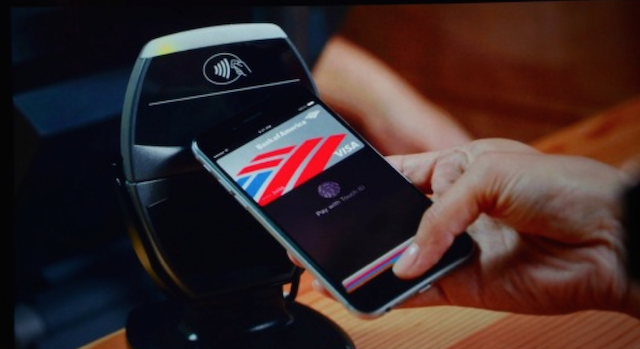
Alongside the unveiling of iPhone 6 and iPhone 6 Plus smartphones, Apple has also launched a new mobile payment system today called ‘Apple Pay’, that allows users to pay at the counter with an iPhone 6 or iPhone 6 Plus. Apple notes that users will be able to use their phones at the cash register in order to pay for everyday purchases, using an NFC antenna, Touch ID, Passbook, and something that Apple terms as the “Secure Element”.
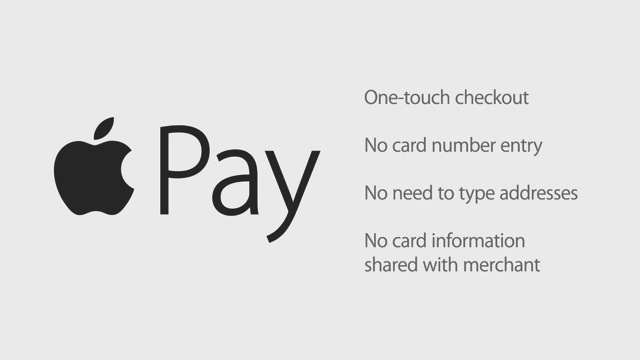
The system basically works by adding a card to a user’s iTunes account, when then gets added to Passport. Apple says that when you add a new card, they don’t store the card or give it to the merchant. They use a one-time payment number along with a dynamic security code, so there’s no longer a static code on the back of the card. Users can also suspend payments from that device if it’s lost or stolen, so there’s no need to cancel the credit card.
With the launch of Apple Pay, the Cupertino giant has also announced a number of partners in addition to its own retail stores which will support the payment system. These include the likes of Subway, McDonalds, Disney, Walgreens, Macy’s and Sephora. Apple says that Groupon, Uber, and Panera have also integrated Apple Pay to allow customers to pay without having to enter any payment information.

A software update will bring Apple Pay to US users with Amex, Visa and Mastercard support in October of 2014. The company has announced an API for Apple Pay as well while adding that it is “working hard” to bring the feature to other countries.



It better come to Canada ASAP. I am going to Disneyland in October so I might be able to use it then.
Hopefully Good news for Canada is that Interac and or Moneris are involved with a giant portion of payments. Also we have touch pads at most POS. If we are lucky that means that the Apple Pay stuff is easy to roll out in Canada.
So – Look for articles mentioning Moreris and Interac by name….
So, wait, if I get the watch then I can use the touch pay, even with my 5s?
Yes
I’m not sure about that. You’ll be able to use most features of the Watch but not Apple pay with the IPhone 5s.
Yes. If you go to the apple site in the Apple Pay section, it will tell you that Apple Pay will work with 6, 6+ and the Apple watch which can be paired with 5, 5s, 6, 6+
If it uses similar technology as our “tap to pay” or “paypass” on our debit and credit cards it will be extremely easy to implement. Even easier than the US.
“Apple says that when you add a new card, they don’t store the card or give it to the merchant.”
I wonder what happens if a card expires – considering they don’t store the information I imagine the don’t have a way to alert you the card may have expired. Just curious about how that would go down.
when your card expires, you get a new card in the mail as always. Just put that new card in your phone and delete the old one.
That’s not what I meant. What I mean is what if you travel a lot and haven’t gotten your new card yet to replace it. Will you know before initiating a transaction that the card you may use has expired – remember that most of the card’s info is obscured to prevent anyone getting pertinent info and apple pay has a default card functionality.
Yeah, not sure how that would work. If your card expires while you are traveling; maybe you’ll have to call the credit card company or your bank.
I’m sure they have figured it out, just not an issue anyone will run into yet – hell, it’s not even out yet. This, however, is why I’m glad we ardent the first group of Guinea pigs…
By the way the Merchant may not know anything about your card but your IPhone will know everything about your card.
We don’t actually know what the extent of that will be actually. We enter in the info, the bank verifies it, it then becomes a token in the device. We don’t know if the device holds onto that info or not… it sounded like it didn’t for security purposes.
I, of course, could be misinformed.