As reported by the folks over at Tesla North, Suncor-owned Petro-Canada has more than doubled its electric vehicle charging rates in Quebec. Charging rates in Quebec are now at $0.45 CAD per minute, up from $0.20 CAD.
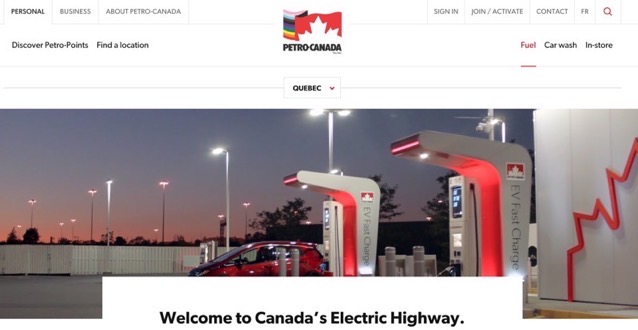
Since the company completed its coast-to-coast DC fast chargers (Level 3) back in January 2020, it has raised pricing in Quebec by 125%. The latest pricing increase has been in place since June 1, 2022, notes the source.
Tesla owners in Canada with CCS-adapter-enabled vehicles are able to charge at Petro-Canada EV chargers as well as at other CCS charging stations across the country.
Below are the full Petro-Canada EV charging rates:
- Alberta – $0.33 per minute
- British Columbia – $0.27 per minute
- Manitoba – $0.33 per minute
- New Brunswick – $0.25 per minute
- Newfoundland and Labrador – time-based billing
- Northwest Territories – time-based billing
- Nova Scotia – $0.25 per minute
- Nunavut – time-based billing
- Ontario – $0.33 per minute
- Prince Edward Island – time-based billing
- Quebec – $0.45 per minute (was $0.20/minute)
- Saskatchewan – $0.33 per minute
- Yukon – time-based billing
For now, this current EV charging price hike from Petro-Canada has only been spotted in Quebec.



how much is a full charge on average?
It’s not economical to fully charge a battery at time-based DCFC stations because the last 20% takes forever to finish.
To give you an idea, at the max speed of 350 kW, a 5 minute charge will give you 150-200 km of range for only $2.25. But you’ll only attain this speed when your battery is low.
If you sit at the station for 40+ minutes waiting for it to fully charge, now you’re paying upwards of $18 for maybe 400 km of range.
This is why time-based billing sucks.
And for comparison, a full charge at regular residential rates should cost no more than $10.
But isn’t this a good thing? As EV usage hits critical mass, time-based billing is going to incentivize users to use public charge stations to charge-and-go. It sounds like time-based billing is going to encourage people to charge what they need, rather than what they want and lead to a larger segment of folks relying more on chargers at home to get that full charge.
This means shorter line-ups and will largely prevent folks from leaving their vehicles plugged-in when they really don’t need to.
Sure when you’re driving long-distances, you’ll want to get that full charge, but I also don’t see fairness in someone unnecessarily hogging a charge station because they like to see ‘100%’ on their dashboard.
Totally true in theory. And I’m already getting ahead of myself, but it’ll likely end up with charging stations prioritizing slower chargers as they improve… since they’ll make more money…
I’d say a hybrid billing system that incentivizes volume, but also charges based on time is probably the way to go in the long run… but we’re just getting started with this right now.
I’m sure provincial governments are going to be looking at this very closely though… the prices of charging stations per province should generally match the prices of electricity plus markup.
Quebec, Manitoba and BC have cheap electricity from what I understand. There should be a direct correlation there.
True, but just because the source is cheap doesn’t mean it will (or should) be cheaper. You still need to recoup some revenue for provincial infrastructure costs, and as EVs hit mass market (we’re not there yet, but will be), we’re gonna have to offset some of those levies on gas over to hydro.
I’m intrigued by your hybrid model though. Care to explain that a bit more? Or is this model published elsewhere that I can reference?
No, I do t have anything in particular.
I was thinking of the way a cab meter ticks down.
The increases at a smaller rate when the car isn’t moving but also ticks faster as the vehicle moves.
So a charger could charge at two rates, a per minute low rate as well as a per watt rate combined.
All in all adding up to the station earning the most amount of money from charging the most amount of cars as fast as possible.
Oh I like this approach! A time component to discourage lingering and an energy component to reflect what was consumed.
And I understand the provincial infrastructure thing but it is a decade too early to worry about that in my opinion. The social cost of burning gas over electricity is still way too expensive relative to the cost of maintaining roads to drive on.
Any additional taxes on electricity (if we think that is necessary at this point) should be clearly explained to consumers on their receipt as additional tax.
Yes it does discourage charging to 100% (which could be a good thing to manage demand/hogging), but at the same time it penalizes cars with slower max speeds.
BC Hydro uses time-based but has multiple tiers for different charging speeds. Tesla imposes an idling fee when not charging. These measures can make it fairer for everyone, as opposed to having a single rate.
Just wait until we are all electric. The price will be $4 a min
That’s like saying just wait until we are all driving gas cars. Gasoline will be $12 a litre.