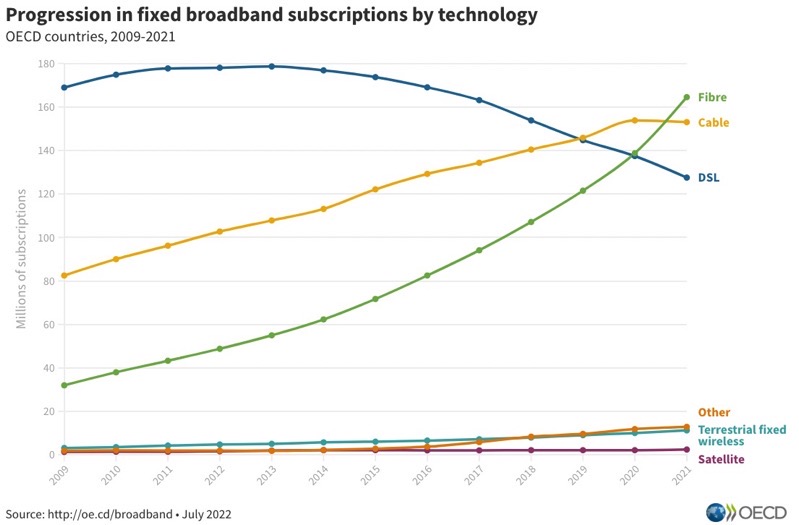
According to the Organisation for Economic Co-operation and Development (OECD), which Canada is a member of, the group says fibre has surpassed cable when it comes to fixed broadband internet for the first time.
An OECD spokesperson told iPhone in Canada across its 38 member countries, 34.9% of fixed broadband subscriptions are now based on fibre connections, according to its latest data.
Canada was ranked 11th with 15.9 million fixed broadband subscriptions as of December 2021.
Fibre internet subscriptions increased 18.6% year-over-year in December 2021, to surpass cable for the first time, taking 32.4% of fixed broadband subscriptions. DSL subscriptions were at 27% and continue to decline.
The largest growth in fibre connections was in Costa Rica, Israel, Greece and Belgium all seeing increases beyond 80% in 2021. Total fibre broadband is now at 50% or above in 13 OECD countries including Chile, Finland, Luxembourg, New Zealand, Norway, and Portugal. Members with over 70% fibre connections include Iceland, Japan, Korea, Latvia, Lithuania, Spain and Sweden.
Fixed broadband internet continues to increase in member nations, seeing a 3.9% increase in 2021, growing from 454 million to 472 million. Switzerland has the highest concentration of fixed broadband subscriptions at 48.4 per 100 people, followed by France (46%), Norway (45%), and Denmark (45%).
Canada is not even in the picture, despite the rosy picture painted by the federal government and its plans to bring high speed internet to all Canadians by 2030.
Canada’s Mobile Data Usage is Far Below the OECD Average
As for mobile data usage, it increased 15% in 2021, smaller growth compared to 2020, but overall seeing an increase of 79% over three years up until 2021.
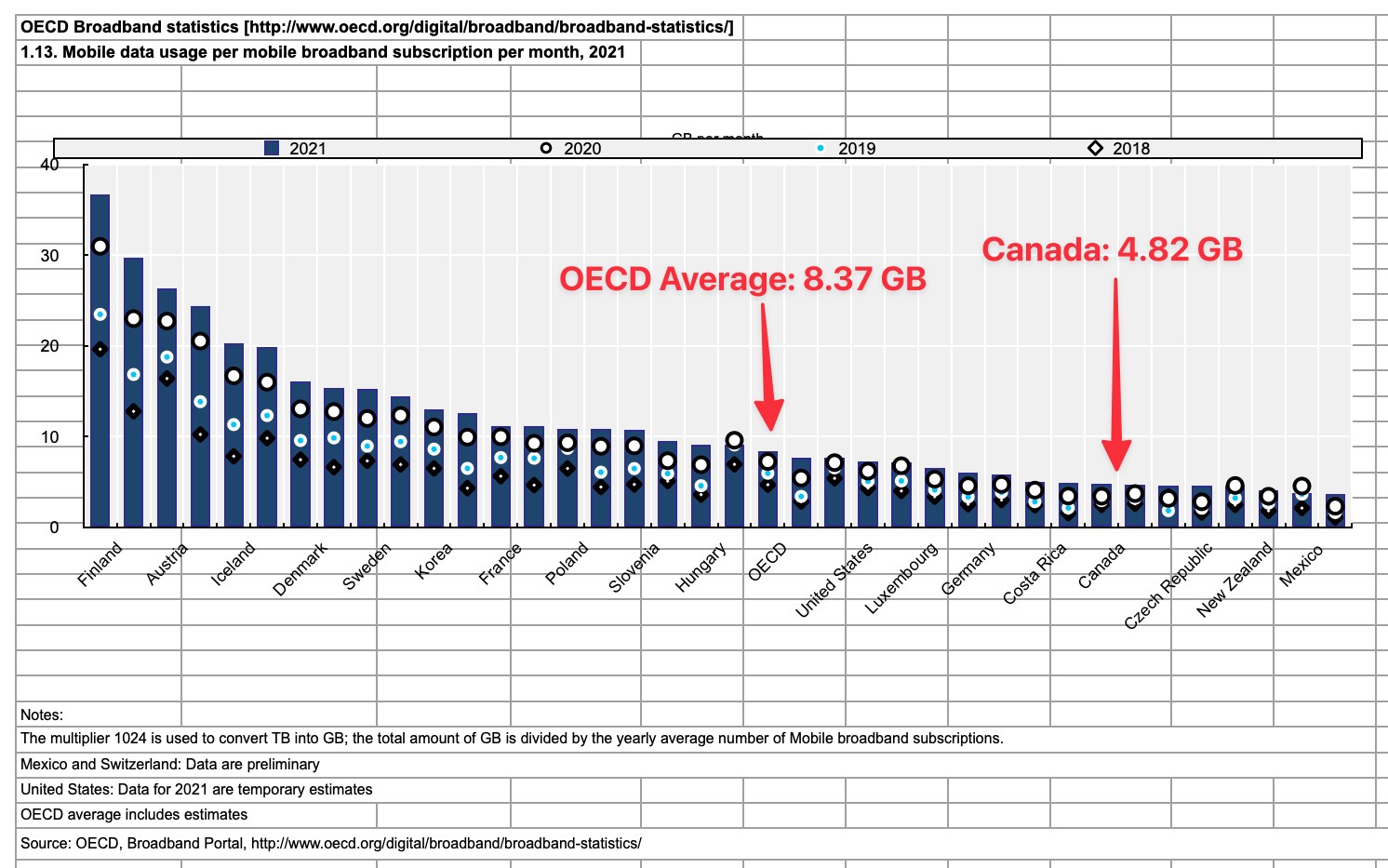
Data consumed averages 8.4GB per OECD subscription per month, but differs by country. Finland leads with nearly 37 GB per month per subscription, followed by Latvia (29.7 GB) and Austria (26.4 GB). Mexico and the Slovak Republic came in near the bottom at just below 4 GB.
As for Canada? OECD data said Canada saw 4.82 GB of mobile data usage per month, far below the OECD average of 8.37 GB. Canada ranks near the bottom, just ahead of the Netherlands, Czech Republic, Colombia, New Zealand, Belgium, Mexico and Slovak Republic.

Mobile broadband penetration increased 5.5% in 2021 and is highest in Japan, Estonia, the United States and Finland, seeing subscriptions per 100 inhabitants at 191%, 180%, 169% and 157%, respectively.
A recent report by consulting firm Wall Communications, commissioned by the federal government, concluded internet prices in Canada have increased consistently since 2019, after the CRTC’s wholesale rates decision.




Since it’s just counting mobile data, I wonder if Canada’s low number has anything to do with widespread access to available Wi-Fi.
Unlikely. Wifi is just as or more available in other countries.
Simplest explanation is price. We pay the highest rates in the world, so of course we tend to restrict our usage.
I was thinking that the places I’m most likely to sit and consume large amounts of data all have WiFi, but I suppose if data was dirt cheap here, hoping on WiFi would really be a consideration.
That was understood.
We do not have more widely available wifi than others. We do have amongst the most expensive data.
Quite the opposite, most OECD countries have better free hotspots. Trust me, the inclusion of VPN service in Samsung phones was not driven by Canada 😉
Well when Canadians still experience $110 + tax per 1 GB overages, you can’t blame them for not wanting to do any sort of mobile downloading…
Make that 150+tax for most carriers. Videotron bumped it up 4 years ago to that level…at at time when 100$ still meant something. No one said boo.
Make that 150+tax for most carriers. Videotron bumped it up 4 years ago to that level…at at time when 100$ still meant something. No one said boo.