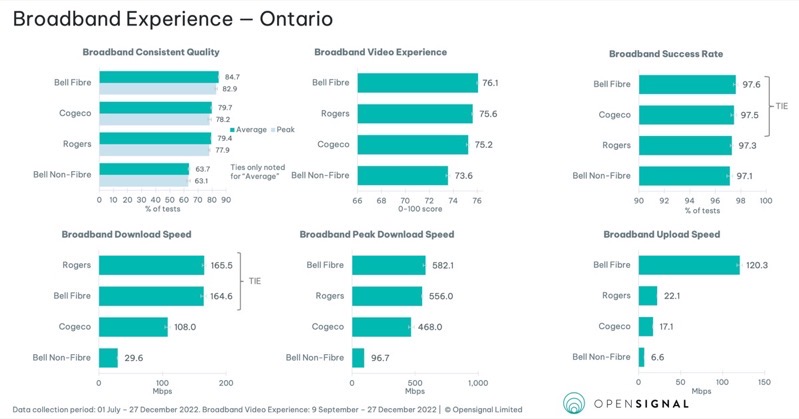
Opensignal released its first Canada Fixed Broadband Experience report yesterday, detailing its analysis of internet providers in Canada.
The report analyzed fixed high-speed networks and rate them on six measures, such as broadband success rate, consistent quality, video experience, download speed, peak download speed and upload speed.
The study showed that broadband download speeds in Canada ranges from 10.9-165.5Mbps, while the broadband peak download speed ranges from 36.2-597.2 Mbps.
As expected, fibre users have the highest scores across most regions. Non-fibre users on Bell and Telus have the lowest scores in most metrics across the regions where they are present.
In Quebec, Bell Fibre outshines Telus Fibre across all six metrics, while Telus Fibre dominates the competition in Alberta’s broadband experience with the highest or tied-for-highest scores in five out of six metrics.
Rogers users enjoy the fastest broadband download speeds in the Atlantic provinces, with speeds averaging 159.1Mbps, beating Eastlink and Bell Fibre by 38.6-45.4% in broadband download speed.
Meanwhile, Shaw tops the list for broadband video experience in Manitoba, and leads over Bell MTS in all three speed categories of broadband download speed, broadband peak download speed, and broadband upload speed by impressive margins.
Telus touted on Friday its outright wins from Opensignal for Consistent Quality, Video Experience and Upload Speed in B.C. and Alberta, as well as its first place in B.C. for Broadband Success Rate.
The company tied for first in B.C. and Alberta for Peak Download Speed, and tied for first in Alberta for Broadband Success Rate. The company said the Opensignal results “demonstrate TELUS’ network dominance in Fixed Broadband in Western Canada.”
“Canadians continue to value a fast, reliable connection and the consistent recognition from independent, third-party organizations, such as Opensignal, reinforces the superiority of TELUS’ world-leading broadband networks,” said Darren Entwistle, President and CEO of Telus, in an issued statement.
Bell and Telus Fibre users dominate the results across most metrics in most regions, concluded Opensignal.



Such a flawed analysis. Should take into account the speed the user is paying for.
(Not that that is possible with the way they are analyzing)
90% of internet slow down issues are caused by the customer.
Tell me you know nothing about network traffic and ISP workings without telling me.
I know more than enough about both. Let me guess you probably use the gateway provided by the ISP
I would like to know average price paid for the said connection by vendor. LOL – Bell is not the best! I feel quite otherwise actually. Would love to be proved wrong with data. Anyone?
It appears that Bell, Telus, Rogers and Cogeco are not much different on fibre and or cable service. I would be very interested in their respective customers’ satisfaction scores whenever repair or customer service is required. In my own experience calls to Cogeco when the internet is down are handled very efficiently because the rep can tell me the exact area of the problem and usually an ETR. Bell and Rogers seem to be even confused about what I am talking about when I call because the service is down. I can not comment as I have no direct knowledge about Telus customer support.
Nice ad for Bell and Rogers. How much did they pay for the lip service?
Half a ham sandwich