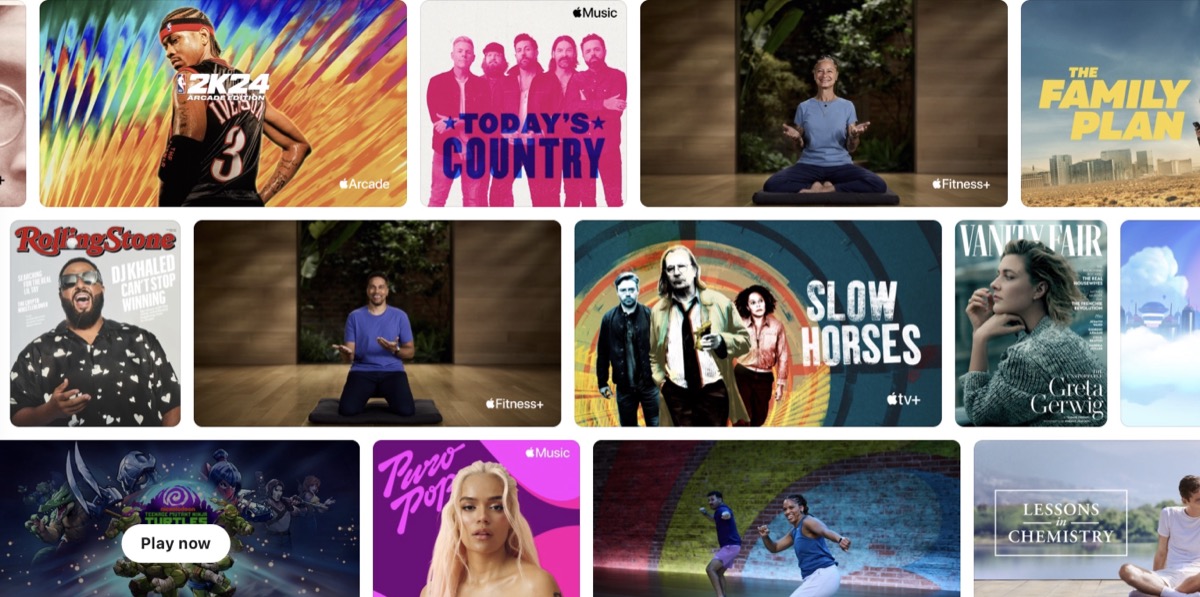
Apple Offers 3 Months of Apple One Free to New Device Buyers
Apple is offering three free months of Apple One with the purchase of a new iPhone, iPad or Mac in Canada, for new and qualified returning subscribers.

I, much like many of you reading this, had been greatly anticipating the Nintendo Switch 2. For eight years, Nintendo Switch has been my companion in the living room and during travels. It was home to incredibly rich and innovative first-person Nintendo experiences, but it was also my go-to console of choice when discovering new indie games. However, by the last stretch of time, I found myself excited at the prospect of a new piece of Nintendo hardware and all the upgrades that’d come of it.
Nintendo Switch 2 feels like an inflection point for the company in a few ways. It reads clear that Nintendo has a great understanding of why the original Switch was so widely adopted. Nintendo Switch 2 retains so much of the initial magic we all experienced when its predecessor made its way to the market in 2017. Nintendo is also showing signs of wanting to become a contemporary contender in the gaming market. With PC gaming handhelds aggressively in the space alongside mainstays in the console realm, Nintendo provides some sorely needed hardware improvements, adopting 4K docked resolutions and up to 120Hz refresh rate when playing in handheld mode at 1080p. The support on GameChat, its native on-device chat functions, has also been welcomed. With all of these genuine improvements made for Nintendo Switch 2, the new $629 console feels like a supped-up ‘Pro’ model of the original Nintendo Switch. It’s safe, familiar, and it feels like home. It doesn’t reinvent the wheel, and after spending a week with the console, I couldn’t be happier.
During both my initial hands-on preview as well as my unboxing last week, I applauded Nintendo for the small, subtle changes made to its hardware. Nintendo Switch 2 feels exceptional in my hands. With an increased 4.5 x 10.7 x .55-inch body, the console is now more akin to a Steam Deck or ROG Ally. It’s comfortable to hold over prolonged periods of time, and even though the Joy-Con 2 controllers aren’t notably ergonomic, it all seems to work. I’ve consistently been able to blast through hours of Mario Kart World or enjoy walking through the streets of Night City in Cyberpunk 2077 in handheld mode.

The new Joy-Cons are slightly larger and easier to hold. They include new features like the magnetic connectors, with the most satisfying click. I still haven’t gotten over how much I love this improvement. Once snapped in place, Joy-Cons 2 are sturdy and won’t fall off accidentally. They still have a bit of give to them. With a quick release button on the back, it’s far easier to remove the Joy-Cons 2 when compared to its predecessor.
However, I’ve adopted the new Switch 2 Pro controller, and this has already become a staple for my play session simply due to how comfortable, lightweight, and long-lasting it is. The addition of the back buttons, with remappable controls, is such a radical improvement. It’s honestly difficult going back to the Joy-Cons 2 at times because of how much I like the added inputs.
Turning the attention to the Joy-Con 2’s new mouse functionality, I’m surprised by how well it works. Nintendo has always positioned its new hardware with some sort of novelty or gimmick. However, after truly using the mouse controls in a natural setting, I’m struggling to believe this feature is a cheap gimmick. It works exceptionally well while gliding the Joy-Con across a surface like a desk or table. Truthfully, I’ve even been able to use it with confidence across my lap while sitting. Will mouse functionality be my primary way of playing? Probably not. However, with games like Cyberpunk 2077 and Civilization 7 already taking advantage of it, I’m going to be curious to see how much support this feature gets in the future.

Nintendo’s meaningful changes to the Switch 2 hardware don’t only apply to bigger features. There are also subtle changes throughout the hardware’s design that go a long way. The matte-like finish across the body of the device and Joy-Cons 2 feel really satisfying to hold. The new kickstand is a drastic improvement over the original Nintendo Switch. It’s far more stable when I place it on my coffee table or counter and play in handheld mode. The inclusion of two USB-C charging ports has also been a phenomenal improvement. Now, I don’t feel constricted in any way when I want to charge the device. On average, I’m finding the Nintendo Switch 2 can readily support up to 4.5 hours of battery when playing in handheld mode. Though I do find that a game like Cyberpunk 2077 will tap the battery faster, dropping the threshold to around 3.5 hours.
Nintendo took a very safe, by-the-books approach when it came to the UI of the Nintendo Switch 2. With the exception of adding GameChat functionality, there’s virtually no difference when navigating the Switch 2 over the original Switch hardware. It’s admittedly a lacklustre welcome when logging into the Switch 2 for the first time. I completed my system transfer, bringing over all of my profile data, saves, digital downloads, etc., automatically. But when all is said and done, I was met with the same UI, same home screen and navigation as the console I was using a week prior. It was very akin to booting up the Xbox Series X for the first time. Nintendo is using a ‘if it ain’t broke’ approach, and I wish the company had at least given some new themes, dynamic backgrounds, or profile icons to choose from to make the Nintendo Switch 2 experience feel more bold and fresh. That said, the eShop navigation has been improved greatly. It’s faster and easier to navigate, so I have to give Nintendo kudos for that.

From a performance and visuals experience, I’m pretty impressed by what the Nintendo Switch 2 is offering thus far. This is without a doubt the most competitive I’ve seen Nintendo be in offering performance in the realm of PlayStation 5 or Xbox Series X/S. Sure, I’m not getting the same stable of high-performance resolutions and performance as I would from the other current-gen consoles. However, we’re at least working within the same realm now. That said, I have no idea how long-lasting this is, but being able to play Cyberpunk 2077 and it being running as well as it does is a marvel. The performance is clearly a cut above that of the PlayStation 4 and Xbox One versions. First-party Nintendo games typically don’t ever disappoint from performance or visuals, so I’m not staggered by how well Mario Kart World or The Legend of Zelda: Tears of the Kingdom Upgrade Pack port handles. Nintendo automatically applies HDR to the entire console experience, which is a little baffling. I found myself having to dig through settings to tweak brightness and other display features like Auto Low Latency Mode and 120Hz support (via max 1440p visuals). I’m glad these settings exist, but I wish there were a better way of knowing how to navigate them for more casual users.

GameChat is notably one of the most premier new features for Nintendo Switch 2. It almost feels silly to sit here in 2025, writing about how novel it is to have voice chat functions on a piece of hardware. Yet, the reality is that Nintendo has struggled to provide chat solutions on its hardware. Yes, no longer am I having to go through the mobile app to start a voice chat party or use other means like Discord. Nintendo’s GameChat is a built-in native option for players. Using the function, I was able to set up voice chat with friends. There are also options to use a camera as well as screen sharing. There are some notable hiccups within the GameChat ecosystem, but that’s largely due to the ways Nintendo has set up the Friends menu and system, making it a bit more obtuse to add friends. Thankfully, the GameChat button on the Joy-Con 2 makes it easy to initiate a party. The camera functionality is very quirky. The video feeds are objectively pretty low-res, but it doesn’t take away from the novelty of it all. Seeing a friend’s little video bubble wiz past me in Mario Kart World is some sort of delight I didn’t know I needed. Screen Sharing let me view up to three friends’ screens as we all played simultaneously. This feature, while functional as intended, isn’t something I’ll use regularly.
With any new piece of hardware, the conversation ultimately lies in the catalogue of exclusive games. In the case of Nintendo Switch 2, the assortment leaves more to be desired if you aren’t a Mario Kart World fanatic. Luckily, Nintendo’s kart racer is exactly what I’ve been looking for after spending upwards of 100 hours in Mario Kart 8 Deluxe. The game absolutely beams off the screen of the Nintendo Switch 2. It takes full advantage of the hardware capabilities, rendering some of the most vivid and beautiful tapestries of animation Nintendo has ever created.

Carrying over much of the core gameplay of Mario Kart, the latest entry of the franchise introduces a ton of new tracks to race on, racers to unlock, and the new Knockout Mode. From this perspective, Mario Kart World has been an exceptionally great experience. However, the game also introduces its Free Roam open world. Here, I spent most of my time aimlessly completing P Switch challenges, unlocking new costumes and other small busy work. However, the map is currently bare with very little to do that feels satisfying. However, under the lens that Mario Kart World may be an evergreen title for Nintendo, I’m eager to see how the game evolves and what’ll be added over the months or years. I have a distinct feeling my opinion on all facets of the game will be elevated with enough ongoing support.
The rest of my time using Nintendo Switch 2 has been spent chipping away in games like Cyberpunk 2077, Split Fiction, and going back into the backlog of games that have received Switch 2 ports and updates like The Legend of Zelda: Tears of the Kingdom. Across the spectrum, Nintendo’s catering of visual and performance options lives up to the promise. There’s a distinct uptick in performance over the Nintendo Switch. The fact that I’m playing Cyberpunk 2077 on a piece of Nintendo hardware almost seems unfathomable. It gives me a lot of hope and promise that third-party support of AAA games is a viable option throughout the console generation.
The Nintendo Switch 2 lives up to its name: it’s an upgraded, more fleshed-out version of the original Switch. It’s familiar and feels like it belongs within the family. However, with that familiarity comes an air of safety. From a hardware perspective, mouse controls, GameChat, and a larger display feel more iterative than revolutionary. That being said, where the generational leap can be felt is within the games. Nintendo has now opened up the door to be in the conversation of where I’ll be playing third-party games alongside PlayStation and Xbox. Nintendo Switch 2 isn’t a Nintendo or indie console; it’s a video game console by true definition.
Want to see more of our stories on Google?

P.S. Want to keep this site truly independent? Support us by buying us a beer, treating us to a coffee, or shopping through Amazon here. Links in this post are affiliate links, so we earn a tiny commission at no charge to you. Thanks for supporting independent Canadian media!

