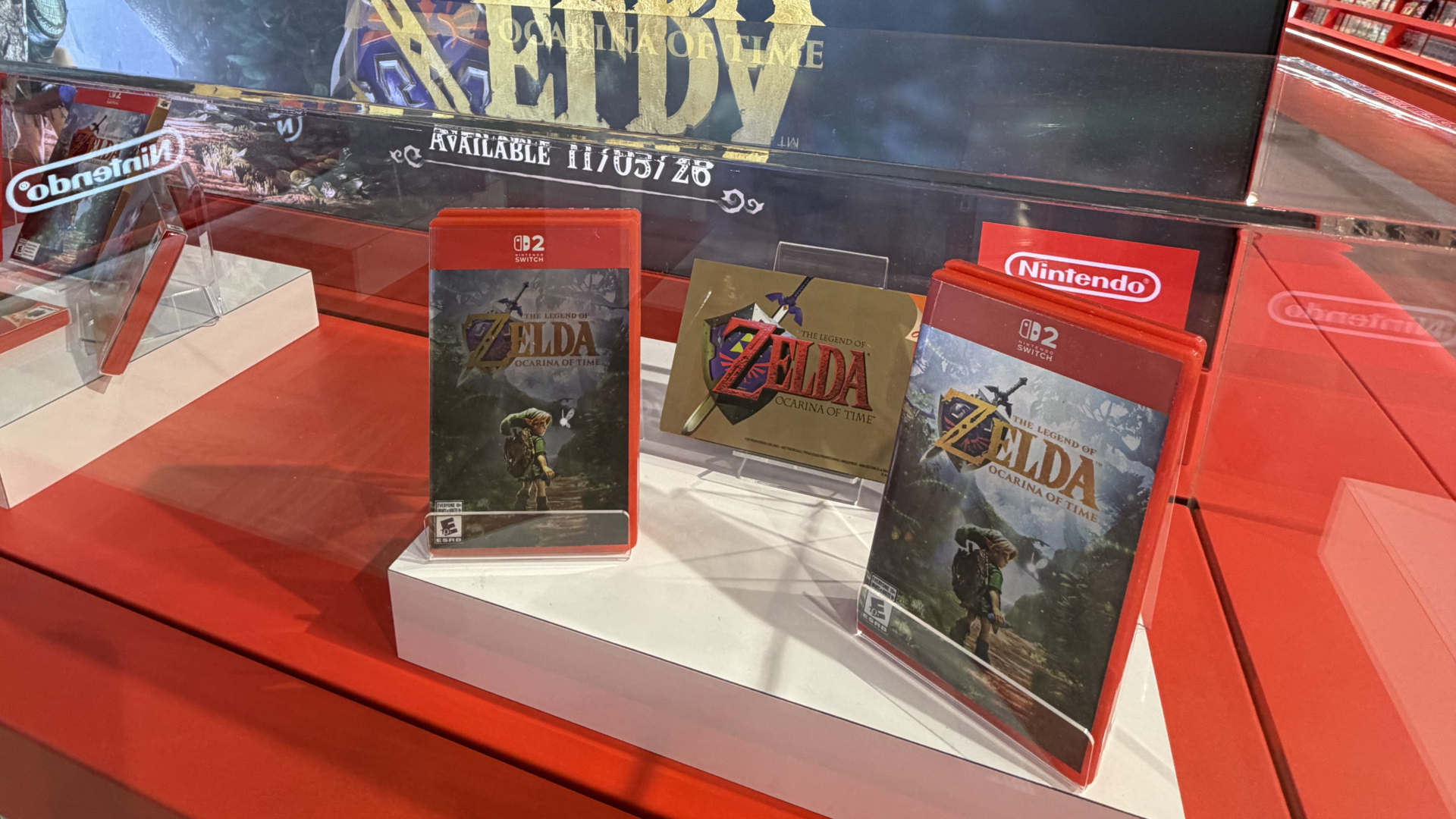
Your First Look at Inside Nintendo’s First Store-Within-a-Store at EB Games Toronto
Nintendo's first North American store-within-a-store opens at EB Games on Saturday, October 17, at 10 AM ET.

At its London Galaxy Unpacked event, Samsung officially unveiled the Galaxy Z Fold 8, alongside the premium Galaxy Z Fold 8 Ultra and the compact Galaxy Z Flip 8. While the Ultra pushes the category forward with flagship camera hardware, the standard Fold 8 takes a different approach. Rather than chasing premium specs, Samsung is expanding its robust foldable lineup with a new design and use case.
After spending some hands-on time with the Galaxy Z Fold 8, it’s clear Samsung focused on making an attractive and well-rounded smartphone for content consumption. It’s thinner, lighter, brighter, and designed to scroll TikTok, Instagram Reels, and watch Netflix. On paper, those may sound like minor focuses compared to its smartphone arsenal. In hand, they combine to make the Fold 8 feel like Samsung’s most approachable foldable yet, with a new book-style design.
The first thing I noticed picking up the Galaxy Z Fold 8 was its weight, or more accurately, the lack of it. At 201g, Samsung says it’s the world’s lightest foldable, and compared to previous Fold models, that reduction is immediately noticeable. It felt immaculate to hold in my hand. It’s roughly the same size as a passport, fitting nicely in my palm and pocket.

Samsung has also refined the overall chassis. The redesigned hinge opens with noticeably less resistance, making one-handed unfolding feel more natural than before. Combined with its slimmer frame, the Fold 8 doesn’t feel like I’m carrying around a traditional smartphone. It’s far more akin to a tablet, albeit a small and sleek one. The design language continues Samsung’s recent trend toward flatter edges and cleaner lines, while Armour Aluminum construction keeps the device feeling rigid despite its slimmer profile.
Unfolding the Galaxy Z Fold 8 reveals a 7.6-inch AMOLED display, while the exterior cover screen measures 5.5 inches. Both panels now reach up to 3,000 nits of peak brightness, significantly improving outdoor visibility compared to previous generations. During my hands-on session, the increased brightness immediately stood out. Colours remained vibrant under bright showroom lighting, and Samsung’s OLED panel continues to deliver the deep blacks and contrast the company has become known for.
The larger inner display remains the Fold’s biggest advantage. Apps have room to breathe, multitasking feels natural, and media consumption simply benefits from the additional real estate. While scrolling through TikTok, videos have enough real estate to maintain every detail. The way the device sits in my hand, I never have to awkwardly stretch my thumb to scroll to the next video. Galaxy Z Fold 8 bridges that gap between the larger display of the Galaxy Z Fold 8 Ultra and the ultra-compact Galaxy Z Flip 8.
Rather than adopting the Ultra’s 200-megapixel camera system, the Fold 8 sticks with a simpler camera setup consisting of a 50-megapixel main wide camera and a 50-megapixel ultra-wide camera. The cover and inner cameras are both sporting 10-megapixel lenses. Both lenses should prove to be great options for capturing photos and video. While I’d love to see a telephoto lens incorporated, it’s clear the Galaxy Z Fold 8 isn’t positioned as a pro-level device.

Samsung is leaning on software improvements through its ProVisual Engine and Galaxy AI to assist in content capture. Dual Recording allows creators to capture both themselves and their subject simultaneously, which will be particularly useful for vlogging or interviews. Horizontal Lock, which first debuted on the Galaxy S26 Ultra, is featured. This helps keep the footage level even when your hands inevitably tilt during recording. I’ve tested this feature before, and it’s great for creators.
Like the rest of Samsung’s latest foldable lineup, the Galaxy Z Fold 8 is powered by Qualcomm’s Snapdragon 8 Elite Gen 5 processor. Samsung claims the new chipset delivers notable gains over the previous generation, offering stronger CPU and GPU performance while significantly improving AI processing through a faster Neural Processing Unit. Those improvements become especially important as Galaxy AI expands across more apps and system functions.
The Fold 8 is available with 12GB of RAM in standard configurations, while the 1TB model comes with 16GB of RAM. Storage options include 256GB, 512GB and 1TB. While benchmark numbers will have to wait until full review testing, navigating One UI felt exceptionally fluid throughout my brief time with the device. App launches were instant, multitasking remained responsive, and switching between multiple windows never felt taxing.
Samsung is also addressing one of the Fold lineup’s long-standing compromises: battery life. The Galaxy Z Fold 8 features a large 4,800mAh battery. Samsung estimates up to 26 hours of video playback, helping narrow the endurance gap between the Fold series and more traditional flagship smartphones. Although extended battery testing will determine how those claims translate into everyday use, the increased capacity is a welcome upgrade.
As with the Galaxy S26 series earlier this year, Samsung is placing Galaxy AI at the centre of the Fold 8 experience. Now Nudge has become significantly smarter by working across multiple apps simultaneously. During a demonstration, Samsung showed how conversations in messaging apps automatically generate restaurant suggestions, calendar events, and navigation shortcuts without requiring users to manually search across different applications.
Photo Assist also receives meaningful improvements. Users can now perform Generative Edit using either voice commands or text prompts, making image editing feel considerably more conversational.

Samsung is also introducing Semantic Search, allowing users to search across notes, files, messages, and applications using natural language rather than having to remember exactly where information was saved. For content creators, Video Auto Reframing automatically keeps subjects centred during playback, while Samsung’s new AI editing tools continue to reduce the amount of manual work required after recording.
The Galaxy Z Fold 8 doesn’t attempt to reinvent Samsung’s foldable lineup. However, with a new design and emphasis on content consumption, the device stands out from the Galaxy Z Fold 8 Ultra and Galaxy Z Flip 8. The lighter chassis makes daily carry noticeably easier, the brighter displays improve outdoor usability, the larger battery addresses one of the Fold’s biggest shortcomings, and Galaxy AI feels more integrated into everyday workflows rather than existing as a collection of isolated features.
While the Galaxy Z Fold 8 Ultra remains the showcase device for Samsung’s most advanced hardware, the standard Fold 8 arguably feels like the more balanced product. It’s easier to carry, retains the multitasking experience that defines the Fold series, and introduces enough meaningful improvements to make this year’s upgrade feel worthwhile.
Whether those refinements justify upgrading from an older Fold will require longer testing, but after spending time with the device, the Galaxy Z Fold 8 already feels like Samsung’s most well-rounded and accessible foldable to date.
Galaxy Z Fold 8 pre-orders are now available starting at $2,399 for the 256GB model. Samsung is also launching 512GB and 1TB storage models. The device is available in Lavender, Graphite, Cream, and Pistachio (online exclusive).
Want to see more of our stories on Google?

P.S. Want to keep this site truly independent? Support us by buying us a beer, treating us to a coffee, or shopping through Amazon here. Links in this post are affiliate links, so we earn a tiny commission at no charge to you. Thanks for supporting independent Canadian media!

good ol samesung, first to market with apple designs. Nothing if not predictable.
Hah. First to the market you are correct. But with apple designs??? How is it an apple design?