Apple TV Adds F1 Academy, but What About Canadian Fans?
Apple TV adds F1 Academy in the U.S. for 2027. Here is what Canadian fans can watch now and why the new deal does not cover Canada.
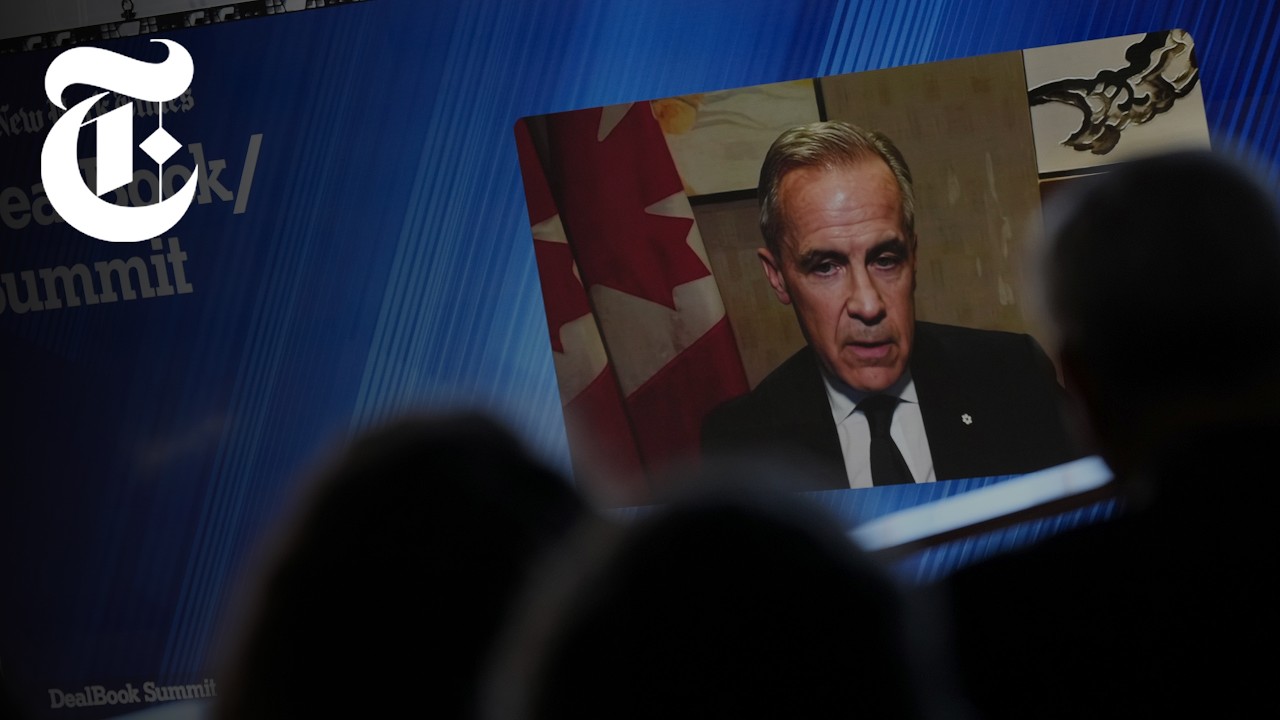
Image: The New York Times / YouTube
Prime Minister Mark Carney says Canada needs alternatives to Starlink, a more competitive North American electric vehicle industry and trading partners that leave the country less exposed to pressure from any one government.
His comments came during a wide-ranging interview with Andrew Ross Sorkin at The New York Times’ DealBook Summit on November 18. Carney joined by video from Shenzhen, China, where he was attending APEC meetings.
He also revealed that he had sold his Tesla, as reported by Tesla North. But the conversation went well beyond his driveway, touching on who controls critical technology, why Canada is buying Chinese-built EVs and how Ottawa wants to reshape its economic relationships.

Sorkin asked whether Canada could find a satellite alternative that performs as well as Starlink, especially if SpaceX’s network keeps improving while competing systems are being built.
Carney’s answer focused on control and national security rather than consumer internet speeds. Citing Ukraine, he argued that reliance on Starlink, or more specifically the related Starshield technology, could turn from an advantage into “a huge vulnerability.”
He said Canada and partners including Europe, Japan and South Korea need to consider whether they can build a backup or sovereign system together. For Arctic and High North defence, he said the important issue is who ultimately decides whether the communications system remains available.
Carney said the goal was not to reproduce a global consumer satellite service with hundreds of millions of applications. He framed the work around systems that governments and their partners could rely on for specific strategic needs.
He acknowledged that building redundancy costs money. “This is insurance,” he said, arguing that recent events had made it harder to assume existing alliances would always provide uninterrupted access to the best technology.
The comments build on Carney’s September pledge to diversify away from Starlink. Ottawa also retains a substantial commercial relationship with SpaceX Canada.
As previously reported, Shared Services Canada’s agreement with SpaceX Canada Corp. grew from $2.26 million CAD in 2023 to a $28.94 million CAD contract for communications and network services. Its end date was extended to March 31, 2027.
Telesat’s Canadian-operated Lightspeed network also depends on SpaceX for transportation to orbit. Telesat contracted 14 Falcon 9 launches to deploy its satellites.
When the discussion turned to Chinese-built electric vehicles, Carney said he had owned one of the Teslas imported from China. He then told Sorkin he no longer had it, adding, “Sorry, Elon.”
Carney joked that the resale price was lower than he expected. Asked why he sold it, he explained that becoming prime minister meant he was no longer allowed to drive.
He defended Canada’s EV arrangement with China as a limited opening. The initial quota permits 49,000 Chinese-built EVs annually at a 6.1% tariff. Carney said this restored the volume Canada had imported before imposing its earlier punitive tariff, while setting a limit that did not previously exist.
He put that volume at less than 3% of Canada’s vehicle market and said the arrangement would remain capped over the next few years.
Carney argued that breaking up North America’s integrated auto industry would leave it less competitive. He said Canadian and Mexican parts and production contribute to the region’s strength, and that concentrating everything in the United States would sacrifice those advantages.
He also said North America and Europe were behind China in the transition to electric, connected and AI-driven vehicles. In his view, governments were spending too much time fighting over auto trade instead of preparing the industry for where the technology was going.
Canada wants to pool resources with its neighbours, he said, but needs a willing U.S. partner.
Carney said Canada’s strategy goes beyond energy, food and defence to include AI infrastructure, space and critical minerals. He argued that both U.S. tariffs and China’s use of critical minerals had demonstrated the risks of economic dependence.
He described recent talks with China as productive, saying an agreement had reduced tariffs and addressed more than 90% of trade irritants. He stressed that much of the relationship concerned agriculture, conventional energy and manufactured goods, while saying Canada did not trade intelligence infrastructure with China.
Asked about the risks of closer Chinese ties, he used canola exports and military satellite systems as examples of partnerships requiring very different decisions. Canada would choose partners according to the technology and the strategic exposure involved, he said.
Europe is another priority. Carney said Canada wants the closest economic partnership possible without becoming an EU member, expanding cooperation in research, regulation, defence and technology infrastructure beyond its existing free-trade agreement.
Carney said the United States remains an ally, pointing to NATO, NORAD and Arctic defence cooperation. But he said a change in political tone alone would not be enough to reverse Canada’s diversification strategy. Lasting policy changes would matter more.
He described Trump as more personable and willing to listen in private than his public appearances might suggest. On trade, however, Carney said the countries still had not reached an agreement that worked for Canada, although talks were moving closer.
Closing the interview, he pointed to a plan to encourage $1 trillion CAD in investment over five years, recent trade deals involving ASEAN and the Philippines, and an expected India deal within three months. He said Canada already had free-trade access to two billion consumers outside the United States and was working toward three billion.
Where should Canada put its technology dollars first: satellite alternatives, a stronger EV industry or closer cooperation with existing partners?
Want to see more of our stories on Google?

P.S. Want to keep this site truly independent? Support us by buying us a beer, treating us to a coffee, or shopping through Amazon here. Links in this post are affiliate links, so we earn a tiny commission at no charge to you. Thanks for supporting independent Canadian media!