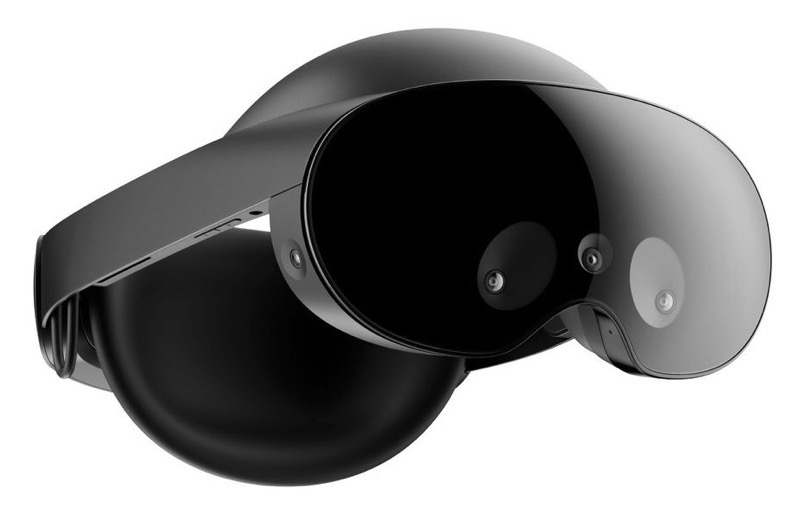
Mark Zuckerberg announced at Meta Connect 2022 today the next-generation Meta Quest Pro virtual reality (VR) headset, which the company says is their newest and most advanced to enter the Metaverse with.
Meta Quest Pro is available for pre-order today in Canada, priced from $2,299.99 CAD and will launch on October 25, 2022, with retailers such as Amazon.ca carrying the device. Included with the headset are Meta Quest Touch Pro controllers, stylus tips, partial light blockers, and a rapid USB-C charging dock.
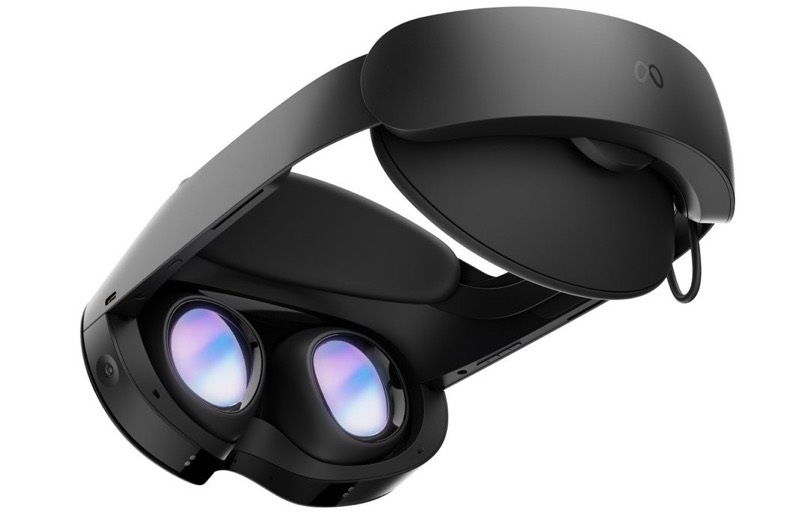
According to Meta, the Quest Pro has high-resolution sensors for “robust” mixed-reality experiences, along with crisp LCD displays for sharp visuals to go with a sleeker design. There’s eye tracking and Natural Facial Expressions to help your Meta avatar look more natural in VR.
“ This… is Meta Quest Pro. It’s the first in our new line of advanced headsets, built to expand what’s possible in VR. It takes what people love about Meta Quest 2 and adds a bunch of new technologies to help you do more in the metaverse. It’s made for collaboration and creativity, and with mixed reality built in, it lets you do things that haven’t been possible before. All in a beautiful design that’s comfortable to wear. Whether you’re looking to work in a new way, or you just want the very best experiences available today… this sets the standard,” said Mark Zuckerberg in a statement to iPhone in Canada.

The optical stack in the Meta Quest Pro has been reduced by 40% compared to the Quest 2, while the new headset has 75% increased contrast with 1.3x larger colour gamut and more vibrant colours. There’s local dimming and quantum dot technology to bring a more engaging VR experience.
The Quest Pro is powered by a Snapdragon XR2+ processor offering 50% more power and performance, along with 256GB storage, 12GB RAM, spatial audio and 10 advanced VR/MR sensors.
Alongside the Quest Pro announcement, Microsoft announced it will be bringing its productivity tools to Meta Quest devices and work experiences. Microsoft Teams, Microsoft Windows 365 for Meta Quest, Microsoft 365 app experiences for Quest, Microsoft Teams/Workrooms integration, Meta Avatars in Microsoft Teams, and Microsoft Intune and Azure Active Directory support for Quest are all coming.
Meta says its VR developer ecosystem is “booming”, citing that over $1.5 billion has been spent on games and apps in the Meta Quest Store to date.
You can watch a replay of the Meta Connect 2022 keynote live stream below:




Wow..for a VR headset..don’t we get a discount for all the data Meta will be getting?!?
If the world worked like that, google would be paying people to use Android.
Ha.ha..that will be so true.
The Meta VR headset will report back to Facebook what you are thinking and where you are.
its the most ridiculous pricing I ever seen, if you wanna play vr, you need to shell extra $50 for the correct mask since this is more of a mixed reality headset. Also, it has the same resolution as quest 2, which was pretty bad as a virtual monitor device. Pico 4 is a WAY better device and much cheaper.
People are not really looking at what this Meta Quest Pro is offering. Each Meta controller (there is 2 of them) is using a Qualcomm Snapdragon 662 SoC, and they have RAM, and storage, as well as multiple camera’s on each controller. They also perform touch and stylus functionalities. When you buy a Quest pro, its like you are getting two smartphones as well, only they are in the shape of hand controllers, and perform 6 degrees of freedom, even behind a users back. In other words these controllers are performing all the users hand tracking without using the Quest pro headset to look for where the user is holding, and moving each controller around in 3d space. That means the Quest pro doesn’t have to use its cameras and processing power to process that information. Therefore this Quest pro should perform even faster than the original Quest 2, because the Quest and Quest 2 used its on board cameras to track the users controllers around the users Quest headset. Meta has offloaded all of that processing onto each of the separate controllers. People do not understand that is a ton of processing power that has been returned back to the Qualcomm Snapdragon XR2+ SoC. It will be interesting to see how Apple, or others will perform this similar task. That is if they actually offer hand controllers. I bought a smartphone in the past that had that same Snapdragon 662 SoC.
This is an insane price that will keep this product in not just a niche market, which VR already is, but a micro-niche market. It won’t help grow VR. It may only end up serving developers by giving them a tool to help make the space/apps of VR. That’s it.
Working in VR will never be a thing. Working in AR with a simple pair of glasses could be a thing. But until you get the giant headset down to a pair of glasses that people can wear comfortably for a full day, neither will ever be a thing.
You are only proving to the world how ignorant you really are. This new Meta Quest Pro, is not only VR, but it is an MR headset as well. Mixed Reality is both Virtual Reality (VR), and Augmented Reality (AR) combined into one headset. This Quest Pro even comes with 2 controllers that support both touch, and give the user stylus support as well. So users can draw not only in the air, but on a piece of paper or document that is on a desk infront of them, to actually write on a physical document (AR). Since Apple’s so called AR headset (vapoware) will not be coming with any expensive controllers, then it will be interesting to see how Apple will pull off that type of problem?
I know it’s MR. And yes, there’s lots of power in the controllers, that’s great. But the fact is, it doesn’t matter. #1. It’s way too expensive. #2. No one will use this to work, and it will never be a thing for work until they solve the size issue. It will be a tool for devs, nothing more.
Does anyone remember 3D television?
That will be how this headset ends up.