The 2018 OpenSignal Report was released today and TELUS emerged as the victor over its rivals Rogers and Bell when it came to 4G speed tests, for the second year in a row.
According to OpenSignal, “In our 4G speed tests, TELUS not only established a commanding lead over its competitors, it demonstrated some truly remarkable results. Our average 4G download for TELUS was 44.5 Mbps, which is among the fastest individual operator results we’ve measured on a nationwide level.”
TELUS speeds at the city level were even higher, with average download speeds at 62 Mbps in Montreal and in Toronto, “an exceptional 70.4 Mbps,” which is 60% faster than the national average.
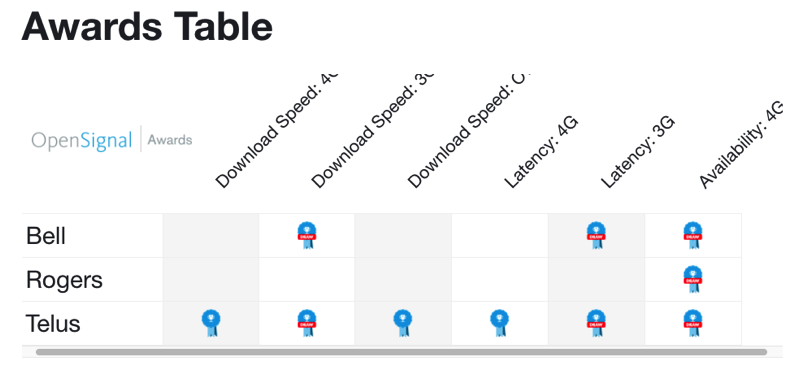
Results show TELUS placing first, either alone or tied, in every category reported by Open Signal including: 4G download speed, 3G download speed, download speed overall, 4G latency, 3G latency and 4G availability.
OpenSignal says last year Bell and TELUS were tied in their 4G speed metric, but that is no longer the case, as the latter’s average 44.5 Mbps download speed makes it one of the fastest operators in the world, based on their tests.
When it comes to 4G availability, Canada’s ‘Big 3’ carriers were tied, as OpenSignal tests found a signal 86% of the time.
TELUS told iPhone in Canada in a statement, “Today’s report further highlights the strength of the TELUS network. In 2017, TELUS won every major mobile network award including J.D. Power, Ookla and PCMag.”
OpenSignal’s report was based on results from 20,474 test devices, which took place from October 1 to December 30, 2017.



Did OpenSignal assess the PATH in Toronto?
Can someone explain to me how Telus is that much better than Bell? Do they not share a network?
They all have their own Cellular antenna
No they do not. Bell and Telus share the RAN (radio access network…i.e. cell towers) across Canada, but they each have their own core networks (i.e. where switching, routing, etc is done, which dictates speed). Each provider (Bell and Telus) has their own connection from the one single shared RAN back to each of their cores. Telus has significantly optimized their core over the last couple of years. Rogers, on the other hand, is completely independent. They do not share anything with Bell/Telus.
Bell and Telus share cellular towers with each other.
In the west, there’s almost no difference.
They do not share a network. They only share cellular towers. My understanding is that TELUS and Bell have separate connections to their own servers. Supposedly, TELUS’s backend is faster than Bell’s. That’s what PCMag and OpenSignal have found.
I don’t know, George. I’m with Telus and there isn’t a Telus tower within 150km of me, just bell and Rogers. Yet I have no problems with service.
That’s not what I said. I said that Bell and TELUS share their cellular towers, but not their networks. You and I are both TELUS customers and we both access Bell towers all the time. But after we access the Bell antennas, it’s all TELUS after that.
Here is how PCMag describes it:
‘The difference between the two networks then becomes their core network design—the lines that come down from the towers, and their connections to the internet. In 2017, it looks like Telus has done a lot of work optimizing its core network in the big cities where the most Canadians live, giving them the fastest possible connections.’
As a reminder, Montreal and Toronto are the only cities in Canada where there’s 4G cellular coverage!
Huh? Theres no 4G/LTE in Vancouver?
Why does the linked article say that Toronto is the capital of Canada?