
SpaceX announced on Sunday its successful use of the Starlink satellite internet technology to post directly from a smartphone to a Direct to Cell satellite, testing out the data feature of the latter, reports Tesla North.
This achievement, detailed in a post on X, involved sending a photo from a location in the Santa Cruz Mountains, showcasing the potential of SpaceX’s Direct to Cell technology to revolutionize mobile connectivity.
SpaceX CEO Elon Musk praised the team for this significant milestone with a “congrats”, emphasizing the enhanced cell signal strength provided by the Direct to Cell satellites, particularly in areas around Silicon Valley.
“The SpaceX team just completed the first post on X from a phone to one of our Direct to Cell satellites! This was the tree cover in a small valley in the Santa Cruz Mountains earlier in the day when we were exchanging some DMs on X,” said Ben Longmier, Senior Director of Satellite Engineering at SpaceX.
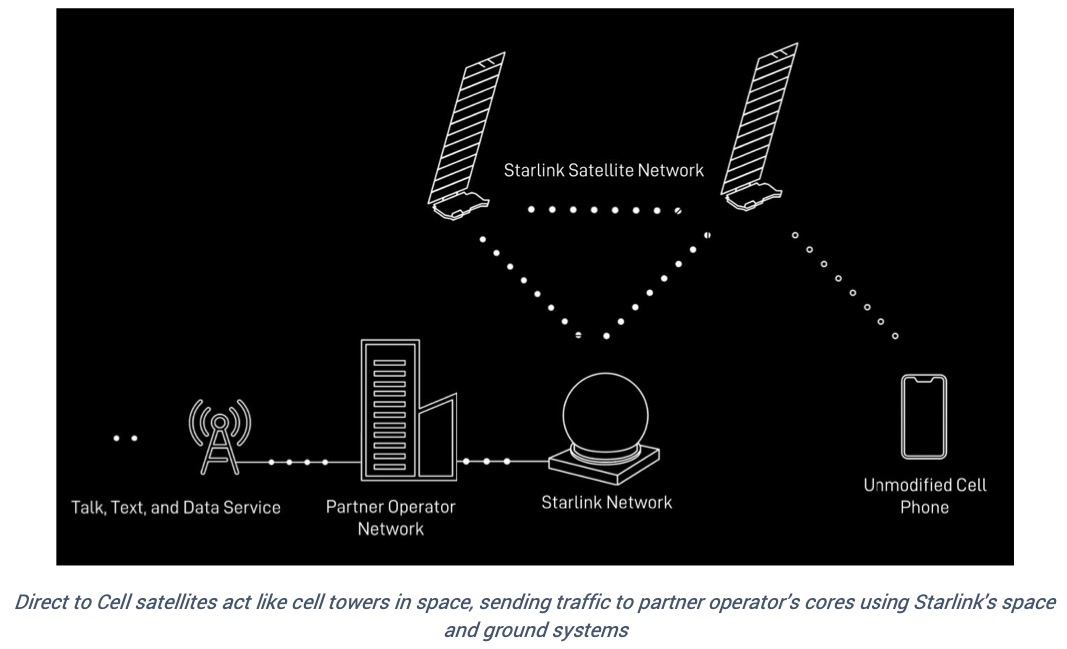
SpaceX’s Direct to Cell technology is designed to allow cell phones to connect directly with satellites. The tech promises to deliver standard LTE service to mobile phones without the need for additional equipment or applications. No cell towers? No problem.

The first successful test of this technology was conducted less than a week after the launch of the first six Starlink satellites equipped with Direct to Cell capabilities back on January 2. These tests, leveraging T-Mobile’s network spectrum, confirmed the system’s ability to send and receive text messages to and from standard cell phones, setting the stage for a wider rollout.
SpaceX plans to expand the Direct to Cell network to offer text, voice, data, and IoT support, starting in 2024 with texting and expanding to more features by 2025. The company’s Falcon 9 rocket will still need to launch a constellation of satellites dedicated to supporting these services.
Notably, SpaceX’s collaboration with global operators, including a partnership with Rogers for Direct to Cell service in Canada, is part of this master plan. These partnerships will enable Starlink to function as a roaming partner for existing mobile networks, allowing direct connectivity for users of participating operators worldwide. Global cellphone coverage everywhere on Earth is coming soon, folks. Welcome to the future (watching TikTok’s from the Amazon Rainforest).



I would like to do this but under Roger’s?! No thanks!
Seems odd for Musk to even want to partner with carriers for this. It’s an entirely separate service that is only related insofar as it also connects to your phone. There doesn’t seem to be any technical reason to involve carriers at all. They add no value and make everything worse.
The only reason I can think of is that carriers might have threatened not to carry/support phones with this unless they are inserted into the business model.
They delayed the adoption of eSIMs by years with similar tantrums when Apple was first proposing them in 2008. The big carriers globally rejected it and said it removed their physical interaction with customers to pick up physical SIMs.