LiberNovo Maxis Airflow Review: Finally, an Office Chair for Tall People
The LiberNovo Maxis Airflow offers a deeper seat for taller people, two levels of ventilation and a comfortable recline. Here’s my hands-on experience.
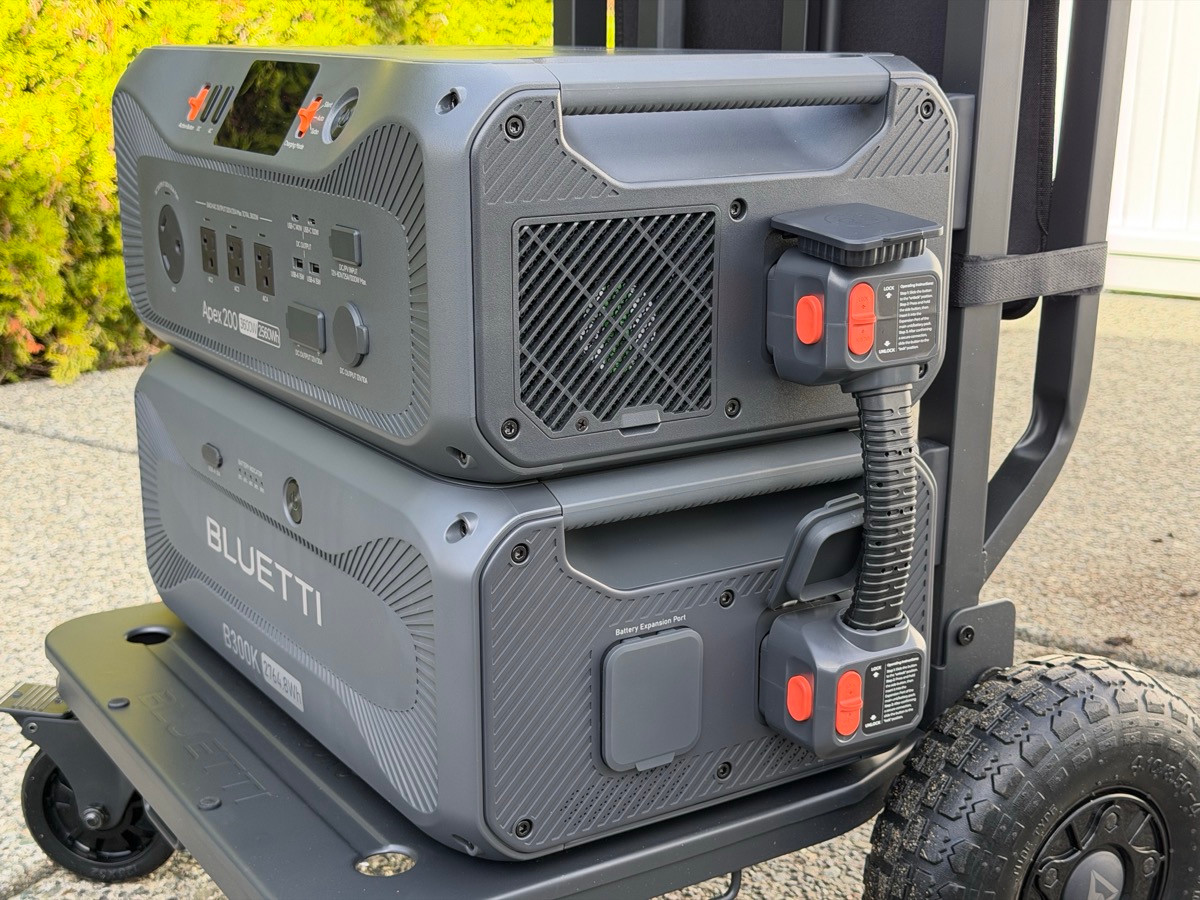
BLUETTI’s new Apex 200 launched in Canada on November 17, and it sits above BLUETTI’s compact Elite series. It’s a 2.56kWh power station with up to 3.6kW of output that weighs 26.9 kg, and you can add expansion batteries later when you need more runtime.
The company sent us the Apex 200 along with its B300K expansion battery, and I’ve been getting familiar with the setup. These are my first hands-on impressions of putting it together and using the cart, controls and expansion battery. I haven’t fully stress-tested it yet.
If you missed it, I recently went hands-on with the much smaller BLUETTI Elite 100 mini, which is the kind of unit you grab for a day trip. The Apex 200 is a different animal. BLUETTI positions it for home backup, RVs and cabins. For me, the main interest is having backup power on hand for winter outages.
The Apex 200 measures 525 × 327 × 211 mm and weighs about 26.9 kg (59.3 lb).
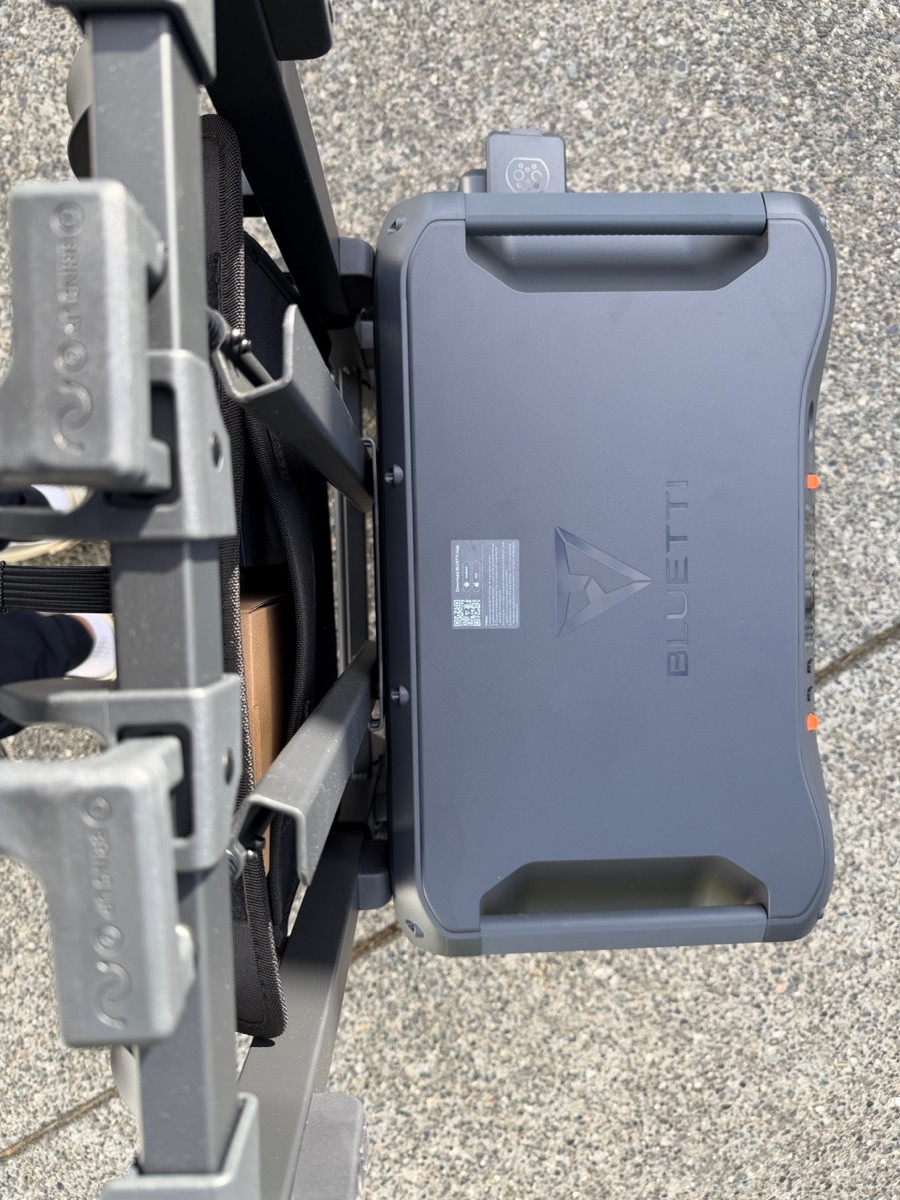
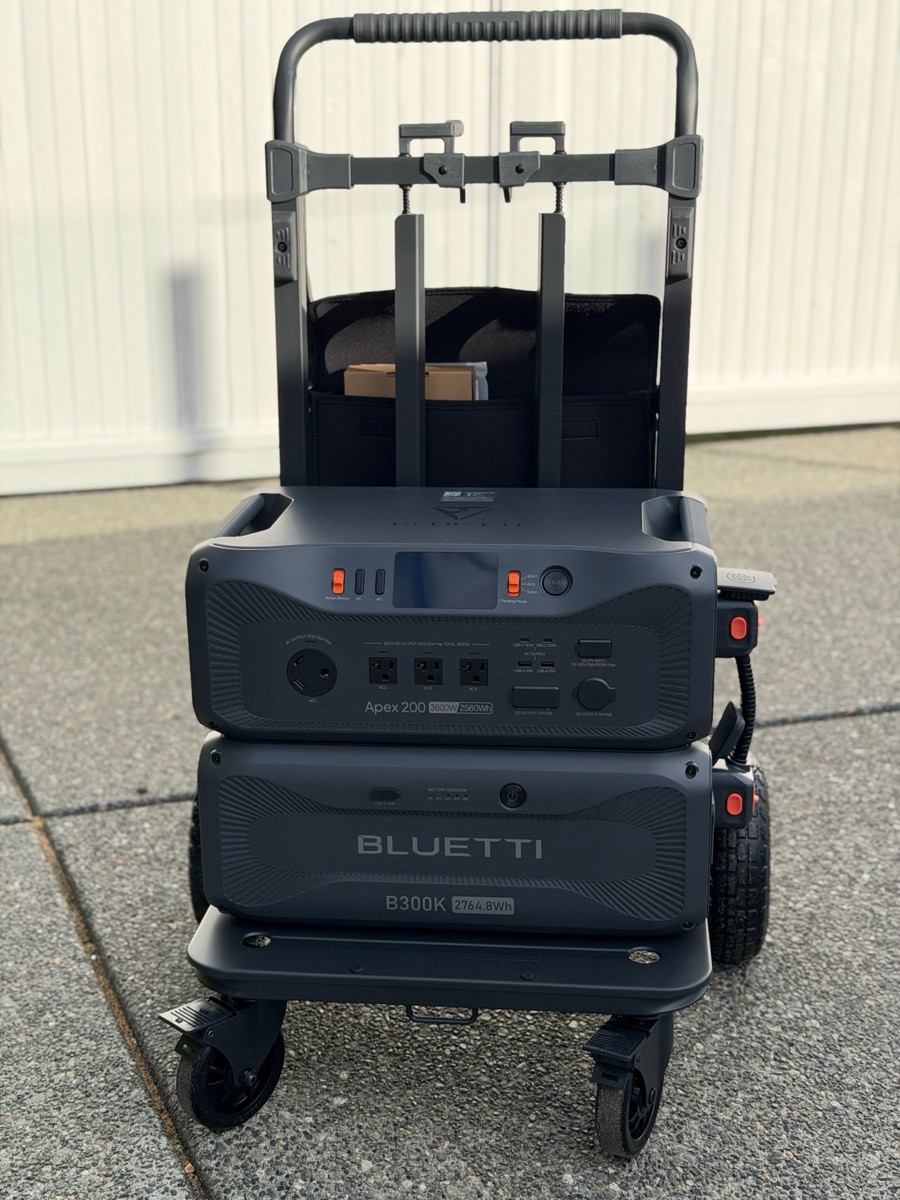
Putting everything together takes a bit of time, but it is easy to do. Once assembled, the setup is simple to use and the whole thing feels well built. My favourite part is actually the cart. The cart you see here is BLUETTI’s Foldable Trolley 2, which is sold separately for $249 USD. The Apex 200 itself doesn’t have wheels. You push it around like a grocery cart, which makes these heavy battery packs much easier to move without having to carry them. It’s super smooth and comes with some beefy rear wheels.
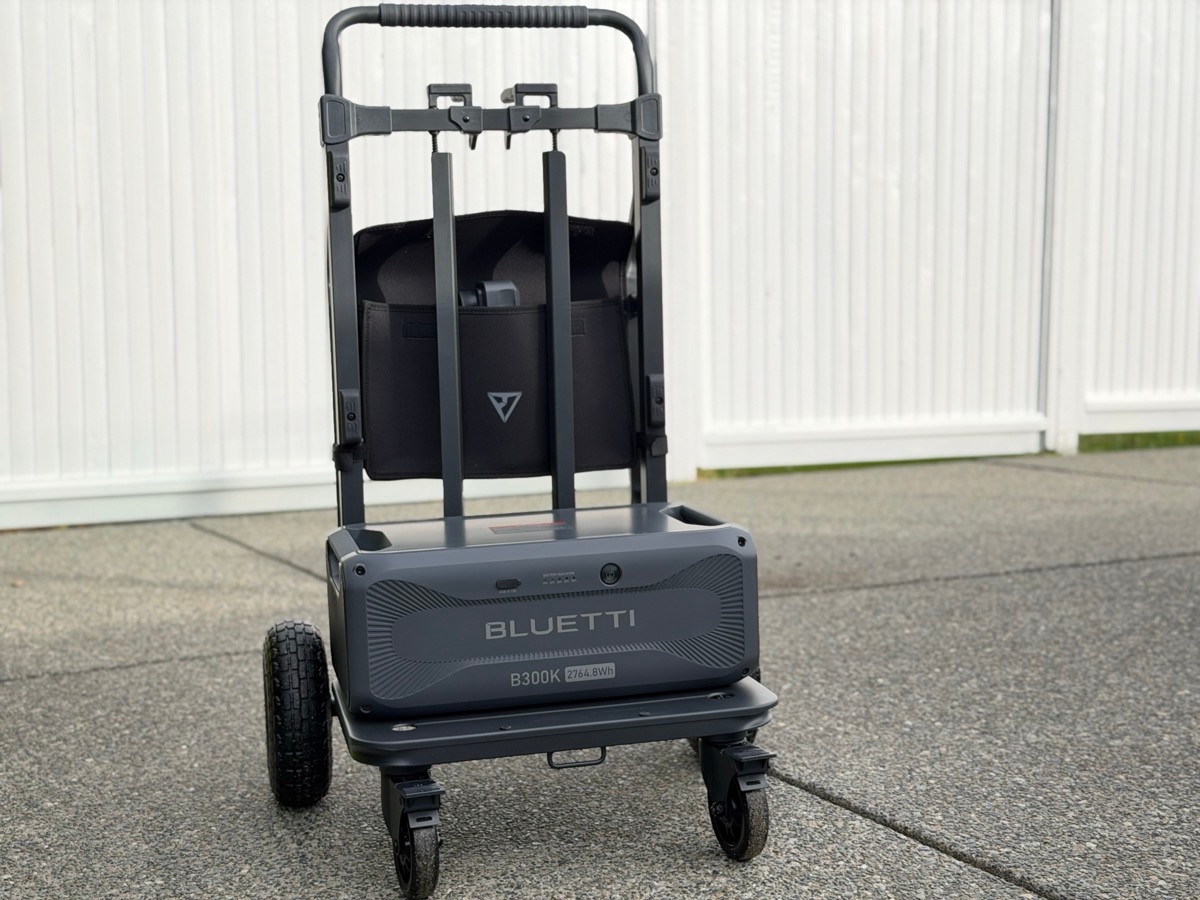
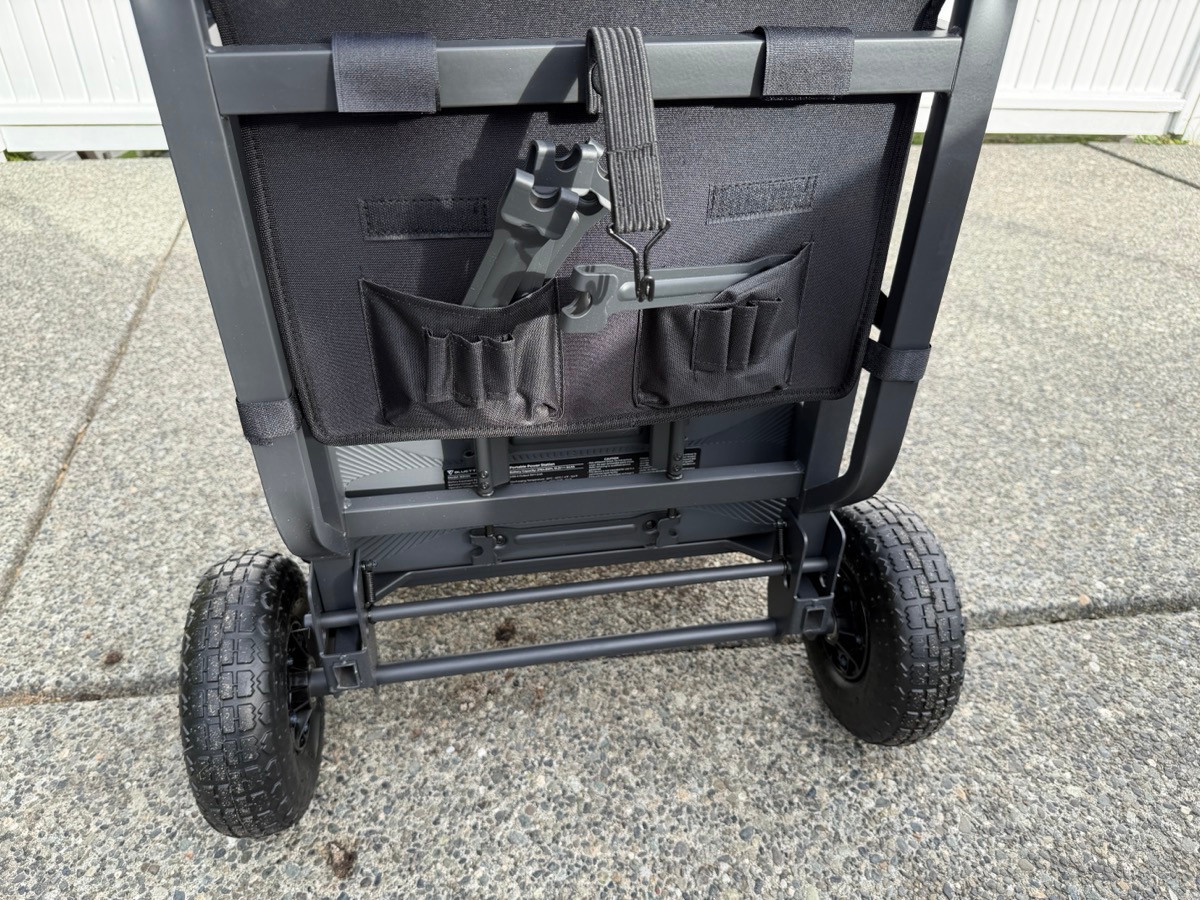
The cart has a nice handle, and the cart’s storage pouch gives the charging cables a home instead of leaving them lying around. It is a small detail, but a useful one when you want everything together and ready to go.
On the front you get the AC outlet indicators, which show the status of each outlet at a glance, plus an action button for features like scheduled charging and ECO Mode. I also like the high-resolution LCD. It gives the unit a more polished feel.
There are 10 output ports in total. You get three 120V NEMA 5-20R outlets rated at up to 20A each, a TT-30R outlet for RVs, a 12V/30A Anderson port, a 12V/10A car outlet, two USB-C ports (100W and 140W) and two 15W USB-A ports.
BLUETTI rates the Apex 200 at 3,200W continuous on its own. That jumps to 3,600W once an expansion battery is connected or when it’s getting power from solar or AC at the same time. Surge power on a single unit runs from 3,360W to 3,840W for two minutes, and up to 4,800W for 10 seconds, according to BLUETTI’s specifications.
The TT-30R and Anderson ports are what make this RV friendly. The TT-30R accepts a compatible RV power connection, while the Anderson port is intended for compatible 12V gear such as portable fridges, lights and fans.
BLUETTI also lists a UPS mode with a switchover time of 15ms or less. I haven’t tested that switchover during a power cut.
The things I would want to use during a blackout include keeping the fridge and freezer going, cooking with an air fryer, drying hair after a quick shower (while there’s still hot water) and recharging our devices. I have not fully stress-tested the system yet, so I cannot put a runtime on that. You also need to stay within its total output and each outlet’s limit, especially if you are running a few power-hungry appliances at once.
BLUETTI lists six ways to charge the Apex 200. The standard 15A AC input is rated at up to 1,800W. Reaching the advertised 3,200W charging rate requires a compatible higher-power connection and cable, rather than an ordinary household outlet. BLUETTI lists 46 minutes to 80% and 1.6 hours to full under its specified test conditions. Combining solar and AC is rated at 47 minutes to 80% and 1.4 hours to full.
Solar input tops out at 3,000W, split between a 2,000W high-voltage MC4 input (60 to 280V) and a 1,000W low-voltage XT60 input (12 to 60V). BLUETTI rates that at 50 minutes to 80% and 1.7 hours to 100%. Those are BLUETTI’s charging figures, rather than results from my own testing.
If you’re on the road, BLUETTI rates its Charger 2 alternator charger (sold separately) at up to 1,000W while you drive, with a full charge in about three hours. A 24V car outlet works too, though at 196W it takes about 15 hours.
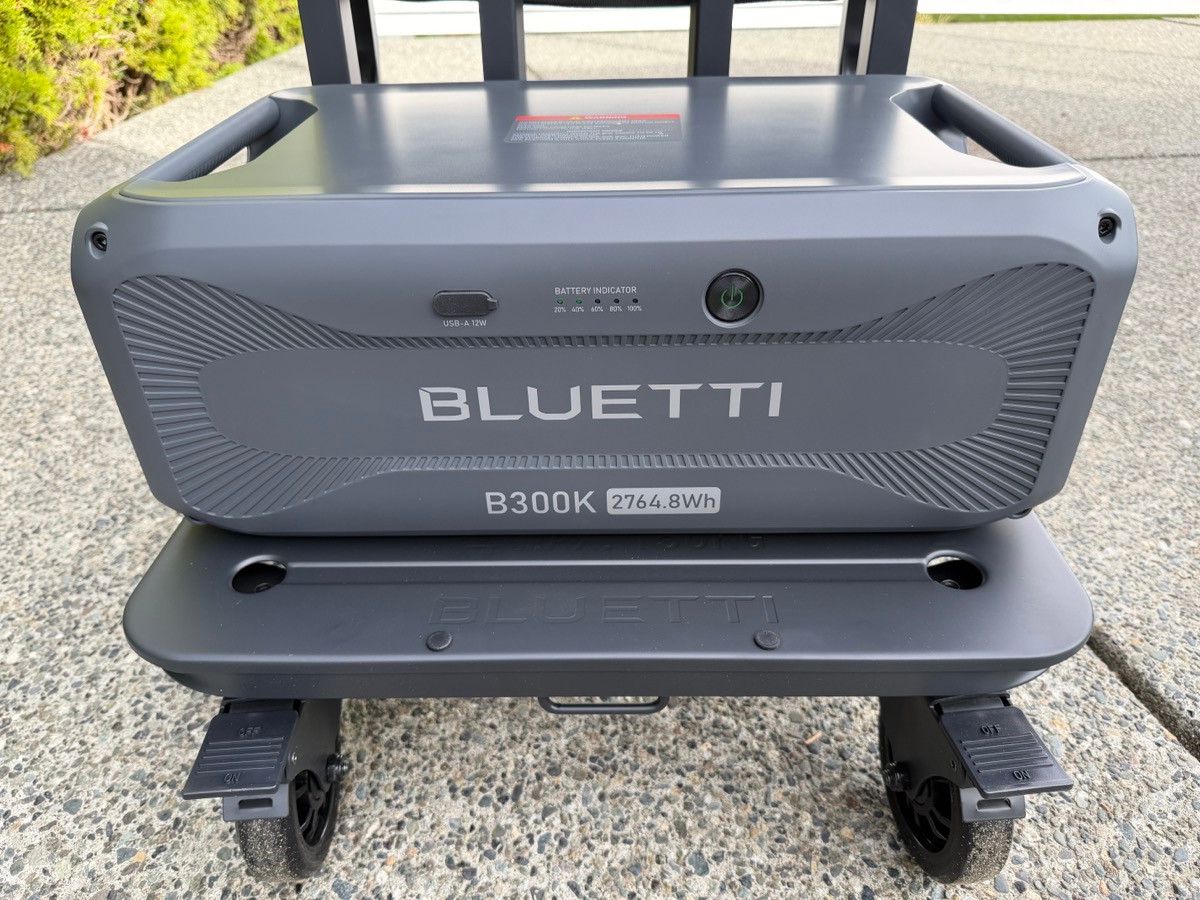
The option to add more storage is a big part of the appeal. You can start with just the power station and add up to six B300K or B500K expansion batteries over time, scaling up to 33kWh. With the B300K attached, as in my hands-on setup, BLUETTI rates the combo at 5.32kWh, roughly double the base unit.
BLUETTI says two or three Apex 200 units can be linked through BLUETTI’s Hub A1 for up to 6kW of output and 100kWh of storage, with whole-home backup kits that can transfer power automatically during an outage. That setup doesn’t support 240V loads, so it won’t run your dryer or a central heat pump.
The expansion battery slides onto the rack and feels very secure once in place. Stacking the Apex 200 above it keeps the setup tidy, and connecting the two is straightforward. This is much nicer than having separate heavy boxes scattered around.
BLUETTI lists individual control of the four AC outlets through its app. You can turn them on or off remotely, schedule appliances around time-of-use rates, and set the Apex 200 to automatically shut off heavier loads when the battery drops so essentials like the fridge keep running longer.
There’s also a Severe Weather Alert feature designed to top up the battery to a level you choose before a storm hits. The Apex 200 also works with Amazon Alexa, Google Home and Home Assistant.
The Apex 200 uses a LiFePO4 battery rated at 2,560Wh (51.2V/50Ah). BLUETTI rates noise at 50 dB max, standby draw at 10.5W, and says the battery loses only about 5% after a year powered off. It can charge between 0°C and 40°C and discharge down to -20°C, so keep it inside if you’re charging it in a Canadian winter.
In the box, you get the Apex 200, an AC charging cable, an MC4 assembly tool, a grounding screw, a quick start guide and a warranty card.
The BLUETTI Apex 200 launched in Canada on November 17 at 9:00 PM EST. Early-bird pricing runs through December 17, 2026. The Apex 200 is $1,699 CAD, down from $1,999 CAD, while the Apex 200 + B300K bundle shown here is $3,049 CAD, down from $3,599 CAD.
Use code IphoneApex200 for an extra 8% off the Apex 200 series at the BLUETTI Canada store.
For me, this setup makes the most sense as backup for winter storms, which is when we usually lose power. My first impression is that it feels well built, with a setup that’s easy to move around on the cart. The cart is what makes it especially practical: I don’t have to lug each heavy battery pack around separately.
The appeal of the Apex 200 is that you don’t have to buy a huge system up front. You can start with the 2.56kWh base unit, then add batteries as your needs or outage worries grow. For now, I like the cart, the tidy expansion setup and the LCD. I still need more time with it under load before judging runtime and backup performance. I’m going to be lending this to my neighbour to test out.
Would you start small with a power station like this, or go big from day one?
Want to see more of our stories on Google?

P.S. Want to keep this site truly independent? Support us by buying us a beer, treating us to a coffee, or shopping through Amazon here. Links in this post are affiliate links, so we earn a tiny commission at no charge to you. Thanks for supporting independent Canadian media!