
PCMag Tests Bell, Rogers, Telus and Videotron: Here’s Who Won
Bell takes the top spot among Canada's four major carriers in PCMag's 2026 mobile network rankings, while Videotron wins on price and reader satisfaction.

Telus has activated its standalone 5G (5G SA) network in Western Canada, just a week after launching the service in Eastern Canada.
Users in Edmonton have reported successful connections to 5G SA on Android phones, with speed tests showing over 1 Gbps. The network is accessible throughout Edmonton, from the north to the south and downtown areas.
Standalone 5G offers several advantages over its non-standalone counterpart. Users have reported improved battery life as phones no longer need to maintain simultaneous connections to LTE and 5G.
The 5G network also promises better coverage, as LTE cells are not required to hand off to 5G cells. One customer noted that areas of their suburban home that previously had poor or no signal now have consistent 5G SA coverage.
“In my suburban house where I have terrible coverage, speeds on LTE are only 1-10 Mbps, and now I get 40-60 Mbps on 5G SA everywhere in my house,” said a Telus customer on Reddit.
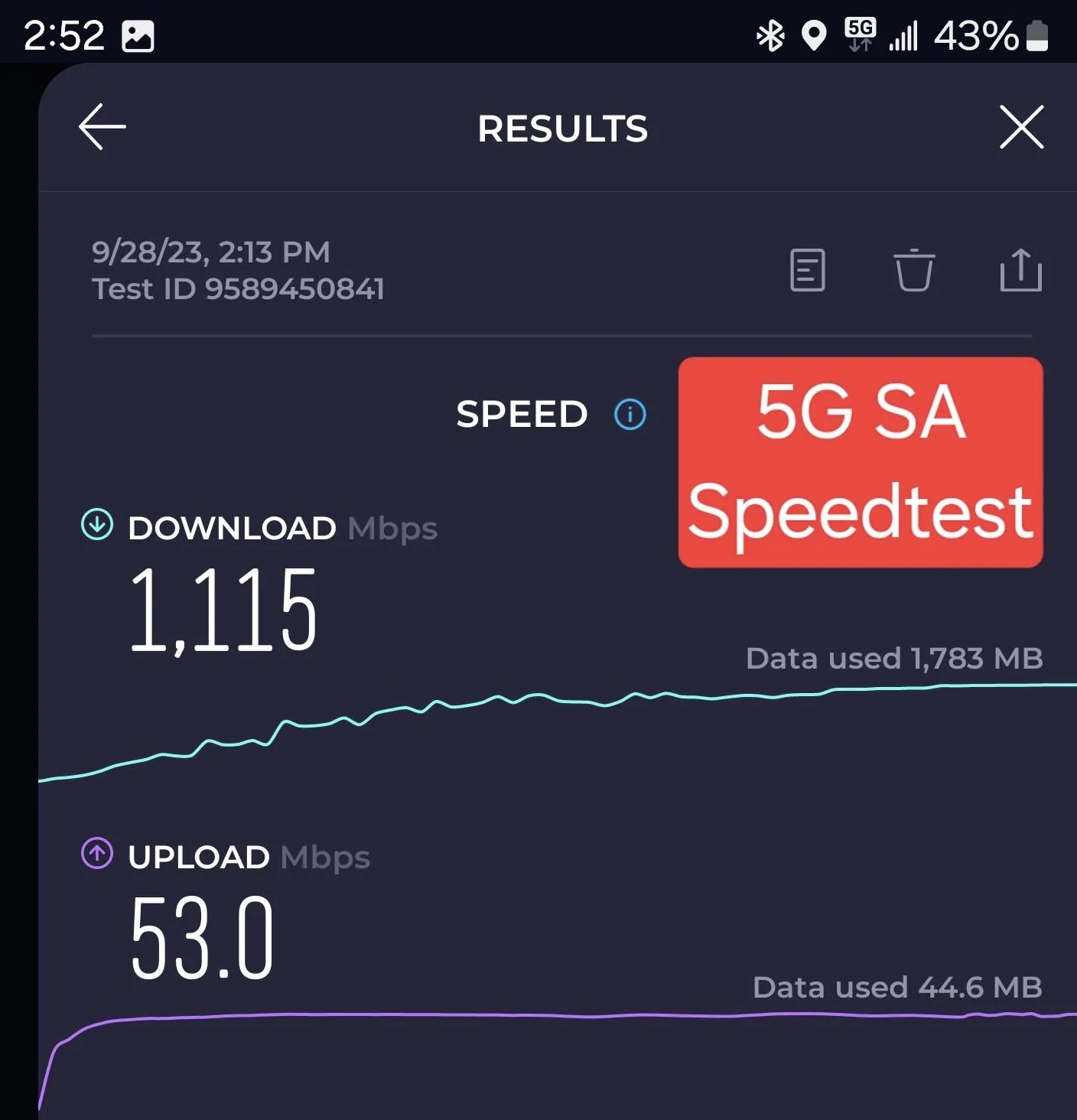
The technology also offers improved speeds and latency, as connections are made directly to 5G without downgrading to LTE. Future updates will enable voice calls to go directly over 5G (VoNR) for better quality, although for now, calls still downgrade to LTE (VoLTE).
For Android users, no new 5G SIM is required to access 5G SA; it works on both older SIM and eSIM after enabling the SA bands on the phone. However, Samsung users may need to wait for a Telus software update to enable the SA bands on their devices.
A Telus spokesperson confirmed with iPhone in Canada the standalone 5G rollout was indeed happening.
“At Telus, we are committed to building world-class networks with the latest technology. Our 5G standalone service is an integral part of enabling amazing social and business outcomes through greater connectivity for devices; enhanced privacy and security features; and faster data speeds,” said the spokesperson.
“As part of our initial launch phase, we have started rolling out 5G standalone in several markets with more to follow. Over time, Telus’ 5G standalone service will provide an accessible platform to enable more use cases across the country,” confirmed the Telus spokesperson.
Want to see more of our stories on Google?

P.S. Want to keep this site truly independent? Support us by buying us a beer, treating us to a coffee, or shopping through Amazon here. Links in this post are affiliate links, so we earn a tiny commission at no charge to you. Thanks for supporting independent Canadian media!


Is standalone 5G same as midband 5g ?
Because I’m already getting 1000-1200down on midband towers near me, about 800ish inside the house.
Standalone refers to a new core network, which means the phone only connects to 5G.
Non standalone requires LTE and 5G to be used at the same time.
Mid band is just a frequency. Mid band can be NSA or SA. More info here:
https://productioncommunity.publicmobile.ca/t5/Get-Support/5G-overview/td-p/836214#M563042
Kind of two different concepts.
Midband 5G refers to the frequency you connect to. Higher bands make for more capacity and speed, but also have decreased range and may drop coverage with obstacles more easily. So a mixture of low, mid, and high band makes for the best experience.
5G Standalone refers to how your phone connects to the towers. 5G non-standalone connects to 5G+LTE at the same time. It’s basically LTE with a bit extra speed due to a little more capacity. 5G Standalone only connects to 5G, which should decrease ping and a few other neat things. However for now phones aren’t going to typically have a great experience using SA.
1.So, there’s no official press release yet?
2. Also, since my Telus sim card doesn’t support “5G Standalone” (I went to my ios settings, voice & data, showing this option is not eligible for enabling), that means I have to purchase a new Telus sim card that supports this, right?
3. It’s not clear whether this 5G standalone means that my 5G connection will only be to the Standalone core network, regardless of which city I’m in? Or is this city by city dependant?
I believe you will need a new SIM card, as we just received a new batch that were specifically described by Telus as 5G SA TRISIM in their ordering system.
I wonder how that applies to eSIMs…
Edit: Used the “Convert to eSIM” option on an iPhone and the 5G SA was no longer greyed out. A no-cost option.
Yep eSIMs are automatically updated to support.
How can we check if we are connected to 5G SA vs NSA?
You have to use the field test mode. But 5G SA is not really working on iPhones at the moment, because the only way to actually get the phone to not connect to any LTE bands is to actually fully disable them. So it’s more a proof of concept than something that’s really in actual widespread use. Also you can’t make any calls over 5G SA yet so LTE is still required for VoLTE.
5g on phones is the dumbest thing ever. limited monthly cap and using it mostly for compressed tiktok shorts.
When 5G SA and VoNR are fully implemented, call quality will be greatly improved, phone battery life will be better, speeds will be better, and in areas of high congestion signal will be greatly improved. What’s not to like about that? It’s a huge basket of positives with very few trade offs.
yeah when….not now. Im talking about now and again you didnt address the monthly cap which will always be the biggest issue. when 5g is unlimited and I can use it as hotspot THEN sure, it will be worth it.
How old are you? What does improved call quality, battery life and reception have to do with monthly caps?
Monthly caps and hotspots have nothing to do with 5G and are just as applicable an issue with LTE which could easily surpass 300 mbps many years before 5G.
trying to insult me by insinuating Im young when even a 4 year old has more logic than you…
Telus doesn’t have 5G network in Canada only you will see 5G simple on your phone I’m over 20 years Telus customer 350-400 mbps on iPhone 14 pro
Is this 5G ?