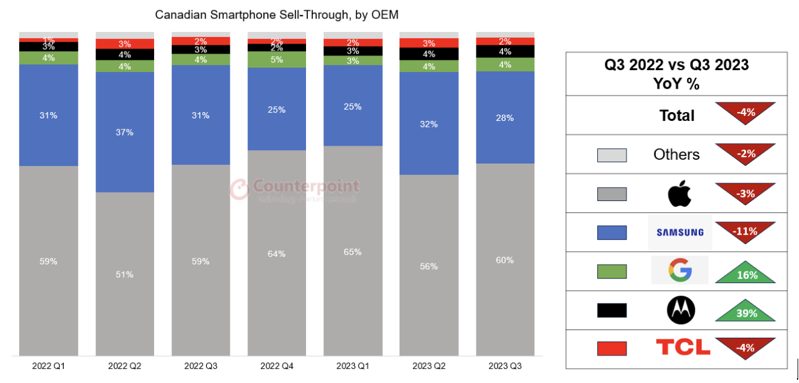
Canada’s smartphone market faced a 4% year-over-year (YoY) sales decline, marking the second consecutive quarter of downturn amid rising inflation and economic challenges.
Despite the usual boost from carrier promotions during back-to-school seasons and new smartphone launches, affordability issues have led to a longer replacement cycle and a shift in focus towards Bring Your Own Device (BYOD) and Certified Pre-Owned (CPO) sales by carriers, according to Counterpoint Research.
Apple has fared better than its Android counterparts, despite a year-over-year (YoY) decline. The iPhone 15 launch was successful for Apple says Counterpoint, even with a 3% YoY decline, due partly to the iPhone 14 series experiencing a longer sales period in Q3 2022 compared to the iPhone 15 in Q3 2023.
Samsung witnessed an 11% YoY decrease, impacted by weaker flagship sales and rising competition from Motorola in the mid-tier price range. Google and Motorola, however, have seen growth from a modest base, impacted by improved retail presence and targeted promotions.
“Economic pressures are impacting high-priced flagship models, leading to an uptick in mid-priced devices. Promotional strategies in carrier channels and retail outlets like Best Buy have become more aggressive. Despite the decline in flagship sales, the Average Selling Prices (ASPs) of new devices are higher, contributing to revenue growth for carriers, as customers opt for higher-value unlimited plans alongside premium device purchases,” said Emily Herbert, Research Analyst, Counterpoint, in a statement to iPhone in Canada.
“Inflationary pressures have led Canadian carriers to focus on trade-in and CPO device sales, contributing to the YoY smartphone sales decline over the past two quarters. Many carriers have promoted BYOD plans, particularly targeting immigrant and international students, and leveraged CPO device portfolios to offer more affordable options on older flagship smartphones,” said Jeff Fieldhack, Research Director.
Looking ahead to Q4 2023 and 2024, Associate Director Hanish Bhatia anticipates a shift in carrier strategies due to the economic slowdown and uncertainties in the geopolitical and immigration landscape.



Because there is no need to change a phone frequently. Especially when the price is really too high.
At one point the power and performance would reach a level which would satisfy maybe 90+% of users. Those users probably won’t need a new phone.