
Mere weeks ahead of the Nintendo Switch 2 launch, I had the opportunity to go hands-on with the anticipated device. As someone who has been eagerly awaiting the release of the successor to the 2017 handheld/console hybrid, it was a bit of a shock-and-awe moment. So much of my time this year has been spent analyzing and fixating on the device from afar. However, ahead of the opening of the Nintendo Switch 2 Experience in Toronto, I got to go hands-on with the device for nearly three hours.
Throughout my time spent with the Nintendo Switch 2 and a rather large assortment of games releasing this year on the console, I had a mission objective in mind. I wanted to analyze some very specific things about the hardware and the software that’s launching alongside the Nintendo Switch 2. Rather than a broad overview of Nintendo’s upcoming hardware, I attempted to learn some specifics that not only made me re-justify my own pre-order of the device but may be useful for anyone sitting on their own pre-order, waiting for the June 5th release.
Here are five major things I learned, spending time with Nintendo Switch 2.
Nintendo Switch 2 feels great in your hands
As we learned during the Nintendo Switch 2 Direct, the upcoming hardware sports a larger 7.9-inch LCD display. Thus, the hardware itself measures in at 4.5 x 10.7 x .55-inches with the Joy-Con 2 controllers attached. This is a notable increase in size over the 4.01 x 9.40 x 1.13-inch dimensions of the original Nintendo Switch. While moderately thinner, the Nintendo Switch 2 has a size that’s best comparable to a Steam Deck or PlayStation Portal. The bump in screen size is noticeable as soon as you hold it. Much to my elation, the device felt great in my hands.
In full transparency, most of my time spent going hands-on with Nintendo Switch 2, I had been using the Joy-Con 2 Grip attachment or the Pro controller. There was an instance when I was able to play Mario Kart World in handheld mode. During that time, I was surprised by how lightweight the device felt in my hands despite the screen size. Throughout my time playing, it wasn’t uncomfortable to hold. The refined Joy-Con 2 controllers felt great to use. The thumbsticks feel really tactile and responsive. Of course, most time will have to be spent playing the device to determine how comfortable it really is to use after a few hours. However, at first blush, I’m pleasantly surprised by the ergonomics of Nintendo Switch 2.
Mario Kart World’s Knockout Tour is a showstopper

I’ve been a lifelong fan of Mario Kart, so the prospect of getting a brand new entry at launch was enough to make me want to pre-order the Nintendo Switch 2. What I hadn’t expected was just how exciting and fresh the new Knockout Tour would be in Mario Kart World. Taking full advantage of the interconnected tracks and the 24-player count, Knockout Tour was my favourite experience of the entire day. The premise itself is simple on paper. Knockout Tour is designed to be a marathon race. The goal is to get from point A to point B without being eliminated.
As the race begins, all 24 players will race to complete each lap. As the laps conclude, the number of top spots available begins to shrink. Starting with 24 players, Mario Kart World’s Knockout Tour then begins to dwindle to 16, then 12, and then eight. During the final lap, the remaining four racers will then compete for the winning spot. Knockout Tour was far more intense and exciting than I could have ever given it credit for prior. It’s exhilarating seeing yourself in the eighth spot, knowing that if you drop down a ranking, you may be eliminated. It makes you want to race better and manage items more practically. All in all, Mario Kart World will eat up a lot of my time this summer.
Donkey Kong Bananza is an authentic-feeling ‘next-gen’ game
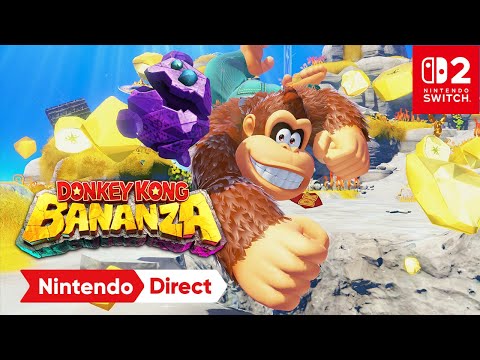
As someone who loves Donkey Kong 64, I’ve been patiently waiting for another 3D game in the franchise. That’s why I was shocked by the reveal of Donkey Kong Banaza, which launches July 17. The game is a 3D platformer, offering larger sandbox-style levels. In this game, players can smash and dig their way through entire levels as Donkey Kong. In search of stolen banana-shaped diamonds, Donkey Kong must explore each level, uncovering secrets. The game feels like a return to classic collectathon games from the N64-era.
Although I objectively had some issues with the pacing of the demo, Donkey Kong Banaza feels authentically next-gen. A lot of time was spent in the 20-minute hands-on sessions learning the controls and going through a tutorial. However, once the game opened up, I began seeing the true potential in the game. The generational bump from the Wii U to Nintendo Switch felt incremental, even when looking at Super Mario Odyssey. However, Donkey Kong Banaza impressed me with its destructible environments, particle effects on screen, and the visual fidelity of the game itself.
Nintendo Switch 2’s Pro Controller is what I’ve been waiting for
Alongside all of the accessories and devices developed for Nintendo Switch 2 is the Pro controller. The newly refined Pro Controller is made exclusively for the Nintendo Switch 2, providing some perks and benefits for games running on the hardware. Historically, I’ve been a supporter of pro-level controllers from all console manufacturers, especially the original Nintendo Switch Pro Controller. However, the new one is above and beyond what I had expected.
While retaining the rough size and dimensions of its predecessor, the Nintendo Switch 2 Pro Controller feels a bit more refined. It includes USB-C charging, which is a nice benefit carried over from the original. The controller also offers motion controls and HD Rumble 2. What truly excites me about the controller is the addition of a 3.5mm headphone jack, which I can see getting a lot of use from myself. Also, the introduction of the rear GL and GR buttons will become a game changer. Also, as a fan of other comparable controllers, being able to map buttons to the GL and GR is great for tailored experiences in Mario Kart World or any other game available on the system.
Mileage appears to vary when it comes to third-party games
On top of offering the chance to try a ton of first-party games at the Nintendo Switch 2 Experience in Toronto, I was also able to test a handful of third-party games. This included Cyberpunk 2077, Hogwarts Legacy, and Street Fighter 6. Nintendo Switch 2 is powered by a custom Nvidia processor. This upgraded chip, when compared to the original Nintendo Switch, helps developers reach the 1080p at 120Hz or 4K at 60Hz benchmarks. However, the results of this vary depending on the game.
Trying Cyberpunk 2077, I was frankly shocked by the resolution and fidelity of the game. What CD Projekt Red was able to accomplish was very reminiscent of playing on an Xbox Series S. The framerate never dipped from what appears to be 30fps. The boldness of the colours and the amount of detail on screen were exceptional. I never thought I’d see the day when Cyberpunk 2077 would be running natively on Nintendo Switch hardware. I only wish I could have said the same for Hogwarts Legacy. The game struggled to retain the polish of its PlayStation 4/ Xbox One counterparts. There were significant performance issues throughout gameplay and cutscenes. Overall, it appears as though third-party quality and performance will come down to each developer and their use of the Nintendo Switch 2 hardware.





Great article. Bananza is misspelled though – correct in the header, incorrect in the body.