Dropped Calls in Penticton? What Telus and Rogers Plan to Change
Penticton residents have reported dropped calls and weak reception. Here’s what Telus, Rogers and Freedom Mobile told the city about their 5G plans.

The 5G icon on your iPhone can look the same at home and at work, even if a big app update downloads in half the time at one spot. Open Maps and you might not notice a difference. A new Opensignal study of Bell, Rogers and Telus helps explain why.
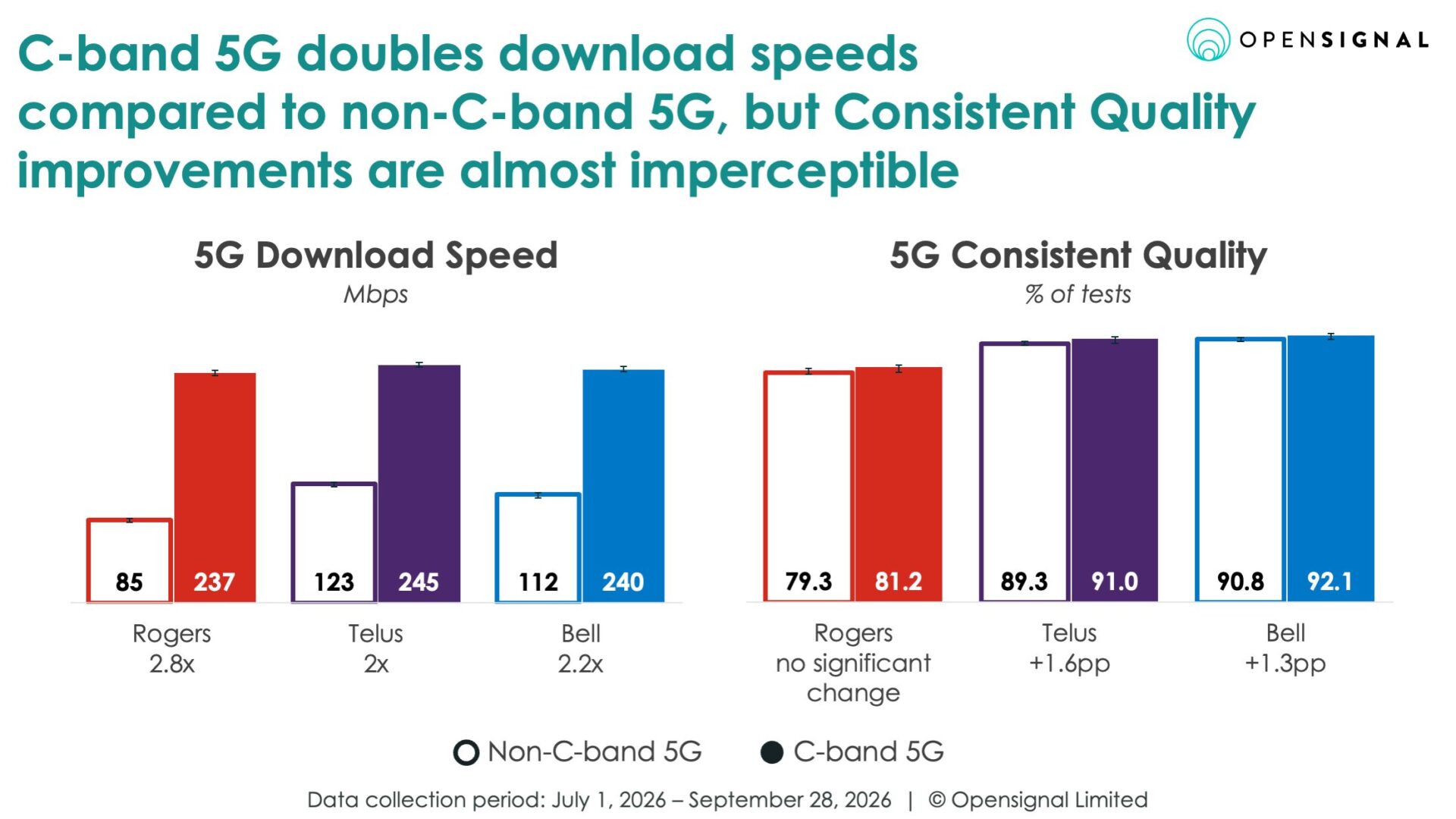
The researchers measured downloads of 237 to 245 Mbps when phones connected on some of the carriers’ newer 5G frequencies, known as C-band. The extra speed made much less difference to how often everyday apps worked well.
C-band is a set of wireless frequencies with more room to carry data. It’s part of what carriers such as Rogers and Bell market as 5G+. The 5G icon alone doesn’t tell you which frequencies your phone is using. Lower frequencies can generally reach farther, so two places with a 5G signal can give you different speeds.
Downloads were 2.0 to 2.8 times as fast on C-band. Rogers saw the biggest jump compared with its own other 5G connections, but all three carriers finished within 8 Mbps of one another on C-band nationally.
Opensignal said in an email to iPhone in Canada that “the experience uplift is marginal.” In other words, faster downloads didn’t make a big difference to how often a connection was good enough for common apps. That share rose 1.6 percentage points for Telus and 1.3 points for Bell, with no clear change for Rogers.
The fastest carrier depended on the city. Telus led for C-band downloads in Toronto, Edmonton and Montreal, while Rogers led in Calgary and Ottawa. Those were the only five cities compared, so the results aren’t a ranking for every neighbourhood or a substitute for Opensignal’s broader national network tests.
In its November 24 report, Opensignal said C-band made up 52% of its Canadian 5G readings in the third quarter of 2026, up from 28% three years earlier. That’s a share of the readings, not a coverage estimate. Looking at all 5G frequencies, Canada’s download speeds were still 18% below the median among developed economies in the OECD.
Would faster downloads make you switch carriers, or is a reliable connection where you live more important?
Want to see more of our stories on Google?

P.S. Want to keep this site truly independent? Support us by buying us a beer, treating us to a coffee, or shopping through Amazon here. Links in this post are affiliate links, so we earn a tiny commission at no charge to you. Thanks for supporting independent Canadian media!