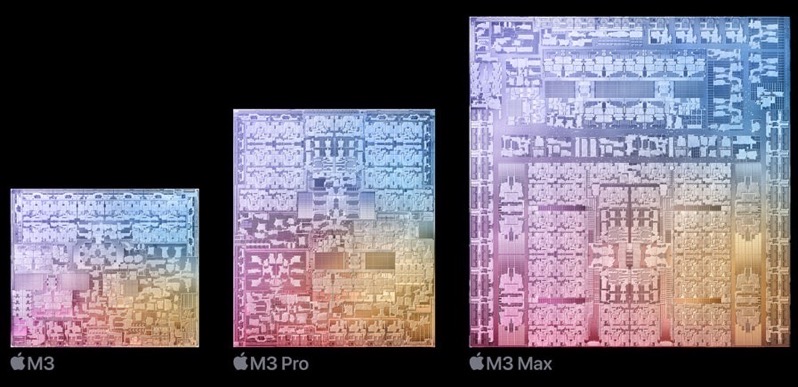
New performance data from Geekbench 6 indicates that Apple’s recently unveiled M3 chip outpaces its M2 predecessor by up to 20% in both single-core and multi-core metrics. The findings corroborate Apple’s assertions made during its recent “Scary Fast” event.
The Geekbench 6 database shows that the M3 chip scored around 3,000 in single-core and approximately 11,700 in multi-core tests, reports MacRumors. For context, the M2 chip had scores of about 2,600 and 9,700 in single-core and multi-core tests, respectively.
- M3 chip: Multi-core score of roughly 11,700 (+20% compared to M2)
- M2 chip: Multi-core score of roughly 9,700 (+17% compared to M1)
- M1 chip: Multi-core score of roughly 8,315
The specific device used for these benchmark tests has not been confirmed but is expected to be either the new 14-inch MacBook Pro or the iMac, both of which are compatible with the M3 chip. The benchmark results were labeled with a “Mac15,3” identifier, which, according to Bloomberg’s Mark Gurman, is associated with a laptop featuring the same screen resolution as the 14-inch MacBook Pro.
The entry M3 chip is equipped with an 8-core CPU and supports a GPU with up to 10 cores. It also accommodates up to 24GB of unified memory. The chip includes advanced GPU architecture with support for hardware-accelerated features like ray tracing and mesh shading, enhancing the realism in high-end gaming experiences. Additionally, a 16-core Neural Engine is integrated for AI-related tasks.
As of now, performance data for the more advanced M3 Pro and M3 Max chips, available in the latest 14-inch and 16-inch MacBook Pro models, have not been made public, but expect them to go live soon as Apple will likely lift its media review embargo early next week.



These numbers are phenomenal if they pan out. With only 4 performance cores, it is over half the performance of even the M2 ultra and its 16 performance cores!
With the 12 performance cores of the M2 Max, it could easily break 30k. This would put it at almost 50% faster than the fastest desktop chips from Intel and AMD that use orders of magnitude more power and can’t even function on battery. That’s truly astonishing if it turns out to be the case.